
From use to impact: How is AI really changing the way we work?
From use to impact: How is AI really changing the way we work?
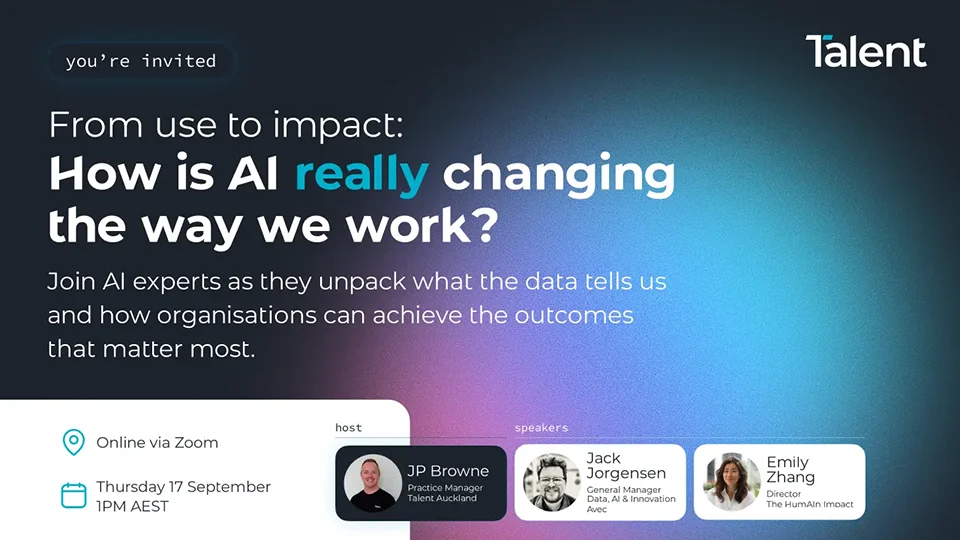
Prefer to watch the conversation?
Hear JP Browne, Emily Zhang and Jack Jorgensen unpack the findings and share their perspectives on AI governance, workforce readiness and measurable business impact. Watch the webinar on YouTube.
Webinar Transcript
Note: This transcript has been edited for clarity and readability while staying true to the spirit of the conversation.
JP Browne: Hi everyone, and thank you for joining us today as we discuss how AI is really changing the way we work. A couple of housekeeping notes: there will be time for Q&A at the end, so please enter your questions during the webinar and we’ll get to as many as we can. There will also be a recording in case you need to drop off early. I’m your host, JP. I’m a Practice Manager at Talent in Auckland, and today I’m joined by Jack Jorgensen, General Manager – Data, AI & Innovation at Avec. Hey, Jack.
Jack Jorgensen: Hey, JP, good to be back with you this year.
JP Browne: I’m also joined by Emily Zhang, Founder and Director of The HumAIn Impact. Hi, Emily.
Emily Zhang: Hi, JP! Hi, Jack. Glad to be here today.
JP Browne: Last month, we released our latest AI research, based on insights from more than 1,500 leaders and professionals across Australia and New Zealand. The QR code gives you ungated access to the full report, and we’re going to explore some of its findings today. Last year, most organisations were still piloting and experimenting. This year, AI has firmly found its place in many workplaces. Now that usage is up and access to the tools is wider, the question is: how can we move from simply using AI to building measurable business impact? At a high level, the report shows that 53% of respondents have implemented AI in workflows or embedded it in strategy. That’s quite an improvement from last year. Eighty-five per cent report efficiency gains, but only a very small proportion can actually measure those gains. On the policy front, 79% say the rules are clear, yet many people remain unsure about what data they can put into AI tools. We’ve seen how quickly AI has moved into everyday operations, but these findings suggest that organisational readiness hasn’t kept pace. Jack, when you look at the findings, what stands out for you?
Jack Jorgensen: It’s definitely that increase to 53% in implementation. It’s a giant leap on last year. When you put that against the 16% who are very confident about what can be used within AI, it makes me quite concerned. You have this extreme growth in adoption with very little change in how confident people are using the tools. That 23% who have never received training or a policy refresh also concerns me, given the giant increase in implementation.
JP Browne: Emily, do you see the same gap from a people and change perspective?
Emily Zhang: Absolutely. At the moment, everyone is racing to implement AI, but what AI is trying to solve is sometimes unclear across organisations. Giving someone access to a tool isn’t the same as giving them the capability to use it. People need to apply judgement, with humans in the decision-making loop. The organisations making progress are treating AI adoption as an organisational change initiative, not just an IT and technology rollout. Three things need to move together: governance, capability and ways of working. How is AI actually embedded into your processes to improve the way you do things? People need to know not just which tools they can use, but what they remain accountable for.
JP Browne: Jack, nearly four in five people say their organisation’s AI rules are clear, but only 16% are confident that employees understand what data can and can’t be entered. Where do you think that disconnect comes from?
Jack Jorgensen: I think it comes down to a couple of things. An organisation-wide policy covering which tools can and can’t be used is a good starting point, and any organisation that hasn’t implemented at least basic governance and policy should do that now. But many policies miss the detail of what information can be entered into AI and what data should and shouldn’t be used, as well as the specific use cases for departments and teams. In one part of an organisation, the data may not be sensitive and can be used quite freely. Other parts of the same organisation may need more stringent rules. Policies need to be tailored and refreshed so teams can use the tools with confidence. Another concern is that AI companies and vendors are constantly changing their policies on how data is used, stored and handled. IT and corporate governance teams must keep checking whether their chosen vendor is securing data properly—and communicate any changes clearly to the organisation.
JP Browne: What does effective AI governance look like in practice, beyond simply creating a policy document?
Jack Jorgensen: Guardrails all over the place are probably the first thing. IT should define the scope of available tools, put new tools through the organisation’s required security checks and ensure appropriate controls and logging are applied—or, in some cases involving personally identifiable information, not applied. I’d also look at how often policy and training are refreshed. Are teams revisiting this every six months to a year? With the technology moving at this pace, having so few people receive current training is extraordinary. Governance requires constant refreshment.
JP Browne: Following on from Jack’s point about training: almost a quarter of respondents have never received AI training or had an AI policy refresh. Even when training is happening, does that necessarily mean people are equipped to use AI well?
Emily Zhang: No—and that’s one of the most important distinctions we can make. I’m seeing a real mismatch in maturity across organisations. Some people are already using AI in an uncharted way, while some organisations have rolled out tools without guardrails or policies. Training is an input; capability and adoption are the outcomes. Knowing how to use a tool doesn’t mean it is being used effectively to achieve the intended outcome. Someone can complete an AI course and still not know when an output needs to be challenged, when to apply critical thinking, what information they shouldn’t put into a system, or how to incorporate AI into their workflow and responsibilities. A fit-for-purpose framework, practical guardrails and clear principles are important—not just a 50-page policy document.
JP Browne: Only a quarter of managers feel very prepared to manage AI within their teams. Emily, why are managers so important to whether AI adoption succeeds or stalls?
Emily Zhang: Managers set the tone. They’re close to the processes and workflows, and they’re the change champions who lead the implementation and rollout of AI. They have a lot of influence over people’s behaviour. AI implementation isn’t just about a tool; it’s about adoption. You need to take people on the journey, and managers are pivotal to that process.
JP Browne: Jack, from a technology and governance perspective, what do managers need to know, and what guidance should the organisation provide?
Jack Jorgensen: Managers should start from the assumption that their teams are probably using AI, even if it isn’t formally embedded in the organisation. I’ve seen a huge amount of grey AI and grey IT, so assuming your team isn’t using it is a concern. Every team produces something—a physical product, a digital product, an asset or another form of output—and the manager is ultimately accountable for its quality and its impact on the business. Managers should define guardrails, standards and governance, and work with the organisation to shape the rules for their department and the teams around them. Any AI implementation should add value, not reduce the quality of what the team produces.
JP Browne: A final question for both of you: how do leaders create enough freedom for employees to innovate without creating unnecessary risk? Emily, would you like to go first?
Emily Zhang: Psychological safety is important, as is leading by example. We’re at a point where people are testing AI and exploring how it can improve the way they work before embedding it into processes. We need to balance the freedom to try with guardrails and frameworks that help people approach it in the right way—without losing data, entering inappropriate information or compromising company security and intellectual property.
JP Browne: Jack, what’s your thoughts?
Jack Jorgensen: From a practical perspective, I’d create environments or sandboxes that are disconnected from production. If you want a culture where people have the freedom to innovate without adding risk, give them a place where they can test, explore and fail safely. That produces far better results than someone vibe-coding against production data and systems. If you want a safe space to innovate, you have to create an environment where the risk is contained.
JP Browne: Moving on to time saved and value created: on the face of it, these findings look positive. But while we may be getting things done faster, most organisations can’t yet demonstrate what that speed is delivering. Jack, does saving time automatically mean an organisation is creating value from AI?
Jack Jorgensen: No. I’m not going to leave it there, though. Saving time in my process is wonderful, but I may have accidentally created a flood of additional work for the teams and consumers downstream. I might be producing more output, but if its quality has declined and another team has to correct it, that isn’t creating value. Different teams also define value differently. Take a call centre: is the goal simply to get the customer off the phone quickly, or do we value understanding and resolving the customer’s issue properly? Time saved alone doesn’t work as a metric. Saving time doesn’t necessarily mean you’re generating additional value for your team or the organisation.
JP Browne: How should organisations account for the total impact of AI rather than just the time it appears to save?
Jack Jorgensen: I’ll lean on software development and engineering. A year or two ago, AI measurement focused heavily on token usage and lines of code. Any software developer will tell you that lines of code is a terrible metric: writing more doesn’t make the work more efficient. Instead, look at the measures that show how a team creates value even without AI. In software, that might include bugs in production, the speed of prototyping and releasing new features, and error rates. Measure those outcomes before and after applying AI or another form of automation, while checking that you’re not creating more work downstream. Start with the metrics that already define what good looks like for the team, then see whether AI moves them in the right direction.
JP Browne: Emily, what happens when organisations make AI adoption or usage the target rather than being clear about the outcome they want to achieve?
Emily Zhang: The biggest issue is that you can end up optimising for activity and volume rather than value. If an organisation sets a target that 80% of employees must use AI, it can achieve that easily but still have no visibility, control or transparency over how people are using it. People might use AI at work to write recipes, plan holidays or get relationship advice—not necessarily to improve their work. You still don’t know whether it has improved productivity, quality, customer experience or employee capability. People start using AI because they’re expected to, rather than because it improves the work. Start with the problem, define the outcome, redesign the workflow and then decide whether AI is the right intervention. A mature AI organisation isn’t the one that uses the most AI; it’s the one that understands where AI can create value and whether the added complexity will improve business outcomes.
JP Browne: Jack, if usage and time saved don’t prove ROI, how can organisations start to measure it? Is there a new set of AI metrics?
Jack Jorgensen: Not really. There are AI-specific costs to factor in—token costs are an obvious one, particularly as subsidies change—but measurement still comes back to what makes the team good at what it does. Use the organisation’s existing measures of success and failure, then keep a close eye on how they change. Don’t be afraid to change a measure if it isn’t useful. If you focus on total usage, people will gamify the system. That might produce attractive numbers for the board, but it doesn’t show that value has been added. You can only demonstrate value by measuring what makes the organisation good, while understanding the side effects you don’t want.
JP Browne: Some organisations are clearly ahead in their use of AI. Emily, how can an organisation assess progress without creating heavy oversight or excessive measurement?
Emily Zhang: The more mature organisations have carefully considered the outcome AI is meant to create. The trick is to measure outcomes, not usage. What does success look like? What are we trying to achieve, and why are we doing it? That ‘why’ is where you gain adoption and buy-in. Without it, people get lost in quotas, which have never been a compelling story to follow. Start with a small, meaningful set of measures linked to the reason AI was introduced and to the specific work of the business. If the objective is faster customer response, measure response time, response quality and customer outcomes. If it’s reducing administrative effort, check whether that capacity is actually released and redeployed into higher-value work. You can add a small number of risk indicators, such as error rates, exceptions, rework and incidents. AI isn’t always perfect, and the output can become cookie-cutter if we don’t keep humans and critical thinking in the loop.
JP Browne: AI creates real value when it improves how people work. How should leaders involve employees in deciding where AI could help most?
Emily Zhang: Start with the people doing the work and involve them as early as possible. Leaders can set the strategy, but the people doing the work will tell you how it can be operationalised effectively. Frontline employees often know exactly where the friction, duplicated effort, system hand-offs and decision bottlenecks are—things leaders may not see. Their insight is essential when designing how AI should be embedded into a process from the bottom up. Instead of leadership saying, ‘We’ve bought this AI tool; where can we use it?’, ask teams what success looks like, what their day-to-day pain points are and where they lose the most time, data or motivation. I would always start with the people.
JP Browne: Jack, what would give leaders confidence that an AI use case is delivering enough value to continue, scale or invest in it?
Jack Jorgensen: It comes down to the measures you set out to achieve. An AI use case has the cost of the application and token usage, the cost of developing it and the long-term cost of running it. Cost isn’t only a dollar figure; it also includes downstream impacts and corrections, as well as the benefits of smoother processes. Establish at least high-level measures around those factors. You should also listen to the teams. Are downstream teams saying it creates more work? I’ve seen organisations implement AI strategies that completely overwhelm the receiving team, forcing them to hire three or four more people to recover the process. Balance the costs of growth and development with the positive and negative impacts on people and downstream systems. That should give you reasonable confidence about whether to invest, pause until the technology matures, change course or stop altogether.
JP Browne: We’ve looked at where readiness is falling behind and why time saved doesn’t automatically equal value created. Let’s bring it together with a quick-fire round on what organisations can do next. Jack, what makes a workflow a strong candidate for AI, and what makes it a poor one?
Jack Jorgensen: I’d look for as much determinism in the process as possible. Automate the simple, predictable portions so you’re not using AI—and paying the associated cost—to make straightforward decisions. Then use AI for the ambiguity: parsing text, analysing customer feedback and processing information that conventional logical control structures can’t handle. That gives you a starting point from which to explore other processes.
JP Browne: Emily, what input should the people doing the work provide before a pilot begins?
Emily Zhang: First, understand the current state: what is happening now, how people do the work and what their day-to-day looks like. Identify the pain points, bottlenecks and issues they want to resolve. Then define the successful outcome. Can AI take us part of the way or all of the way, and how should it be embedded to improve the process? The fourth element, which is particularly important in AI implementation, is human accountability. Where a process will rely heavily on AI, decide where human decision-making must remain and who is accountable at each point.
JP Browne: Jack, before introducing AI into a workflow, what should an organisation baseline—and, perhaps more controversially, who should own the result?
Jack Jorgensen: The person accountable for the process should own the result. If you want to outsource a task to AI, that’s fine, but you’re still accountable for what it does. That accountability sits with the team and, by extension, the organisation. If something goes wrong, it still sits on your shoulders. From a baselining perspective, identify the measures that define improvement for that process and track whether you’re hitting those targets as you go.
JP Browne: Sticking with you, Jack: what are the non-negotiable guardrails every AI pilot should have?
Jack Jorgensen: Don’t touch production. The number of AI systems I’ve seen developed directly in production is unsettling. Keep the data somewhere that can’t affect production systems, maintain backups—and then maintain more backups. When the pilot begins to interact with production, start slowly. Put a few cases through, turn it off, check the results and make sure it’s behaving correctly. Ramp it up gradually, with a ‘whoopsie-daisy’ handle that lets you switch it off quickly and roll back automatically if something goes rogue.
JP Browne: Emily, how do you make those guardrails useful enough that people follow them rather than find a workaround?
Emily Zhang: A 50-page policy will get lost, and both the technology and sentiment around it are changing quickly. You’ll constantly be updating that policy if it’s your only guardrail. It’s more practical to establish clear principles about what people can and can’t—or should and shouldn’t—do, supported by examples. Set out escalation paths: how people identify and raise an issue, and who they raise it with. Be clear about approved tools, such as using the company’s GPT rather than a personal account, and provide role-specific guidance. Some AI tools will be relevant to certain functions and not others. The risk appetite and framework have to be practical so everyone understands what good and responsible use looks like.
JP Browne: Beyond simply knowing how to use a tool, what should role-specific AI training give people and their managers?
Emily Zhang: Role-specific training should answer practical questions. What can AI help me do well? What shouldn’t I use it for? How do I check its work, and who checks it if I don’t? What am I still accountable for? Am I accountable for managing the AI’s work or for the ultimate delivery? How does this change my job, and where can I reinvest any time saved? For employees, that means practical capability: prompting, evaluating outputs, handling data appropriately and recognising when something isn’t working. A business or function might build a useful prompt library, an endorsement process or a process map. Leaders need an additional layer covering workflow design, quality assurance, performance expectations, team capability and how roles may evolve. I’d put particular emphasis on judgement. As AI gets better at producing answers, the differentiator is knowing whether the output is fit for purpose and ready for its intended audience.
JP Browne: Jack, what decisions should managers be trusted to make, and what guidance needs to come from the organisation?
Jack Jorgensen: Managers should have some freedom to make decisions for the processes they’re accountable for. There still need to be overarching policies and restrictions, particularly around personally identifiable information, but managers should also be able to escalate an issue so the organisation can work through it. Organisational guidance should make the boundaries clear, including who to speak to about security, overreach, excessive use and costs. Beyond that, you want to harvest ideas from across the organisation because you will find diamonds in the rough. The organisation should make exploration accessible while maintaining the safety and security it needs.
Emily Zhang: It’s freedom within a frame: flexibility, but within clear boundaries. The organisation and its leaders need to identify and communicate those boundaries while creating the psychological safety for teams to explore and be curious. Curiosity is one of the biggest traits we’re seeing behind successful AI use and the redesign of work to make it fit for purpose.
JP Browne: It’s interesting that you’re both touching on guardrails so heavily, because many of the audience questions are about exactly that. One final question for both of you: what is one practical action an organisation could take next week to move from AI use towards meaningful impact?
Emily Zhang: For me, it’s going back to the problem we’re trying to solve. Where are we now? What do we want to do better? How do we think AI will help, and how will we know we’ve succeeded? From a change perspective, ask: what are we doing, why are we doing it, how are we going to get there and what does good look like? The horizon might be six months, 12 months or years, depending on the complexity.
Jack Jorgensen: I’ll swap hats with Emily and talk about people for a moment. There’s real merit in creating a forum where people can share what has worked, the problems they’ve run into and how they solved them. Someone may realise that an idea also solves a problem elsewhere. Most organisations are more siloed than they like to admit, and people focus so closely on their own context that they don’t see what’s happening in other areas. Create a regular, safe space where teams can explore and test ideas together. That can shift you from several people separately using ChatGPT to make PowerPoint slides to recognising a shared use case for a pipeline of asset creation. You won’t discover that without collaboration.
Emily Zhang: It’s a ‘build it once, share it for all’ approach, which creates another time saving. I love a hackathon: get everyone together to bounce around ideas. You don’t know what you don’t know. You might be using a tool one way, then hear that the person next to you is prompting differently and getting a better PowerPoint output. There’s a lot of value in sharing ideas and being curious together.
JP Browne: Before we move into Q&A, a final question for both of you. AI use is becoming standard. What separates someone who simply uses the tools from someone who can apply them responsibly and create real value?
Jack Jorgensen: Oh my God—slop. Slop is the easy one. I see people take an idea, put it through ChatGPT, hand the result over without reviewing it and ask for a proposal. When you speak to them, they don’t understand their own process. That doesn’t serve the organisation. You’ve created a giant hole and a giant problem—a kind of human DDoS attack—because that person can no longer work through the issue properly, and I can’t provide an effective solution because they don’t understand the problem. The difference between simply using a tool and applying it well is understanding what you’re applying it to. I’ve been saying this for years: don’t outsource understanding. Don’t outsource your understanding of your processes and hand everything to AI. It will come back around and make it look as though you don’t know what you’re doing.
Emily Zhang: I agree with Jack. I’m seeing a lot of proposals and write-ups that look stock-standard. Now that we’re more familiar with how AI produces content and PowerPoint slides, we can spot it a mile away. That’s absolutely fine, but it’s where the human decision-making loop matters. Check your work—at least proofread it. If AI has saved you time, use that time to critically evaluate what it created before you send it. Remove irrelevant wording and anything you wouldn’t normally say.
JP Browne: From a recruitment perspective, it’s a very similar theme. Using AI to draft cover letters and résumés is absolutely fine, but know that you’ll have to explain what’s on your CV to another person. I’ve heard stories of candidates who didn’t check what AI added. In an interview, they were asked about a scenario or technology listed on their CV and had to admit they hadn’t done it. In a highly competitive job market, that doesn’t help. AI can do plenty for your job search, but as Jack said, don’t outsource your understanding—because someone is going to ask you about it. Thank you both; this has been a wonderful discussion. ‘Slop’ may be my new favourite word. Let’s move into the Q&A. We’ve received quite a few questions about guardrails, including this one: what standard guardrails and policies should be in place when starting an AI platform? And I’ll add: is there currently a standard approach?
Jack Jorgensen: From a technical perspective, first create an environment where you can switch between production and a user acceptance testing or test platform. Put controls around prompt injection attacks, and remember that the threat goes beyond what a user enters. Agentic tools may scrape websites and pull assets from across a network, and those sources can contain prompt injections. Restrict and monitor what goes into and out of your network and the AI platform. In sensitive environments involving personally identifiable information, apply PII masking. Logging and monitoring are post-process controls, but you can also pre-process text before it reaches the AI to scan for issues. You can pre-process almost all the data that is about to go to an AI tool. Guardrails should sit at the front end as well as in post-use analysis.
Emily Zhang: Jack has covered data security and privacy. From the people side, focus on responsible use and human oversight. It sounds obvious to say ‘check the work’, but we know that doesn’t always happen. Embed human accountability and clear checkpoints into the process. You can’t simply rely on AI to have done the right thing.
JP Browne: The next question is: how should organisations think about AI’s impact on roles and workforce planning without jumping straight to headcount reduction? From my perspective, I keep coming back to Emily’s point: what are we trying to solve? Headlines about workforce reductions aren’t always entirely about AI; other factors are often at play too.
Emily Zhang: Sometimes people use AI as an excuse: ‘We’re embedding AI, so let’s restructure and call it AI implementation.’ We’ve seen mass exits in the headlines, but also mass recalls. It comes back to the organisation’s accountability to do the detailed process design properly and involve frontline employees sooner rather than later. When strategy and budget cuts come from the top, whether AI is blamed or not, they don’t always support a successful transition into business as usual. Doing that detailed design properly from the outset is essential.
Jack Jorgensen: We had a very similar question last year, when headcount reductions in the US were being attributed to AI. At the time, I suggested AI might be covering for companies trying to reduce their bottom line, and that later proved to be the case. If we remove the headline noise and look at organisational structure, will AI change headcount, roles or the scope of roles? Absolutely. It would be naïve to think otherwise, just as the scope of agricultural roles changed when tractors were invented. But rapidly removing people—and the intellectual property they hold—because a tool has optimised part of a process is short-sighted. Those people can add value elsewhere. If an organisation is always focused on reducing headcount and costs, is it thinking enough about growth? How can it redeploy people who already understand the business to improve and grow the organisation? Using AI as an excuse for headcount reduction is a poor approach.
JP Browne: This next question comes from another angle. Some people are worried about employers monitoring their work. Could recording employees’ screens as they perform daily tasks—with clear context about what they need to achieve—be a useful first step for AI to analyse workflows and suggest improvements? You can see possible benefits, but it may not be great for employee engagement. Jack, what are your thoughts?
Jack Jorgensen: I’m a privacy nut, so this doesn’t sit right with me. Could it be used that way? Yes. Should it? Probably not. Many employee processes are asynchronous: you work on 10% of one thing, switch to 10% of something else, then move again. That multitasking makes screen recordings difficult to piece together. Tools already exist to analyse system logs and workflows, which is much more efficient than processing screen images and usually produces better results. A static log can show what happened down to the second. Screen recording also creates a significant ethical concern. Even where organisations tell employees not to use work devices for personal purposes, there is a risk of capturing non-work activity and personal information, which can create legal problems. There are better ways to do it.
JP Browne: We’ve talked about training and keeping it current. One audience member asks: with AI models being updated so frequently—and models behaving differently for the same workflow or automation—how should organisations manage that change? Emily, that’s your area.
Emily Zhang: Yes and no—it depends on the kind of training. Are we talking about technical training, behavioural training, how people use AI, or learning a particular tool? Technology is evolving every month. People can complete LinkedIn Learning or supplier-provided technical training, but experiential learning—actually using the tool—is often the most valuable and effective way to learn. Of course, you can experiment more freely with ChatGPT than with a financial-modelling tool, so the approach depends on the function and the technology. Technical learning is one component. The other is adoption: the mindset and the safe space people need to use AI effectively rather than simply run with it.
Jack Jorgensen: I’ll add one technical point. Models do behave differently, but new or different doesn’t automatically mean better. If you’re already achieving excellent accuracy, you may not want to upgrade. Manage model changes by running them against a test suite, so you can compare Model A with Model B and understand the difference in performance. We’ve built these for several organisations, and they can produce some eye-opening results.
JP Browne: Following on from that, AI output is improving, but many people still worry about losing human judgement. How should organisations decide where human review remains essential?
Jack Jorgensen: Where you don’t want to end up on the news.
Emily Zhang: If there’s one key takeaway from today, it’s that humans need to remain in the loop. Embed human accountability as a checkpoint.
Jack Jorgensen: It comes down to where you don’t want to end up on the news. If the work involves customer master data, anything going into the field, customer complaints or customer service, I’d want much more oversight—or at least a tool that knows when and how to escalate to a human. We’ve seen cases where AI tools promised things to customers, the organisation was taken to court and the promise was upheld. Ask whether an error could end up in the newspaper or on television. If the answer is yes, put stronger human review and guardrails around it.
Jack Jorgensen: A detailed answer on building a test suite would take more than an hour, but at a high level, you want to run the same prompts through each model and have a consistent way to measure the outputs and their accuracy. Another audience question about fear is interesting. Personally, I don’t see increasing fear around using AI, but I do see heightened anxiety about how AI is being used. There’s an important distinction between the two.
JP Browne: Emily, what are you seeing? Are levels of fear around using AI increasing or decreasing?
Emily Zhang: I think they’re decreasing. There’s less fear and more familiarity with AI. People are coming on the journey more organically, and it’s becoming widely accepted that AI may play some part in producing an artefact—whether it helps someone get started or proofreads their work. In many workplaces, that’s now expected. The biggest call-out is still that the person remains accountable at the end of the process and must check the output.
JP Browne: We’ve reached the end of what has been a very enjoyable webinar. Thank you very much, Jack and Emily.
Jack Jorgensen: Thanks so much.
Emily Zhang: Thank you, JP.
Ready to turn AI use into meaningful impact?
Whether you need the right people or the right delivery expertise, Talent Group’s specialist brands can help you move forward.
Build the capability behind your AI plans
Talent connects organisations with technology and transformation professionals who bring technical expertise, sound judgement and a clear focus on business outcomes. Find AI and technology talent.
Prepare your workforce for what’s next
Solve helps organisations align their people, roles and workforce strategy with changing ways of working, so AI adoption is supported by the right capability and operating model. Prepare your workforce for change.
Move your AI plans into delivery
Avec helps organisations identify valuable use cases, strengthen governance and deliver AI initiatives connected to measurable business outcomes. Strengthen your AI delivery.