
Episode 8 – Not Just a Radio Host with Kent “Smallzy” Small
Episode 8 – Not Just a Radio Host with Kent “Smallzy” Small
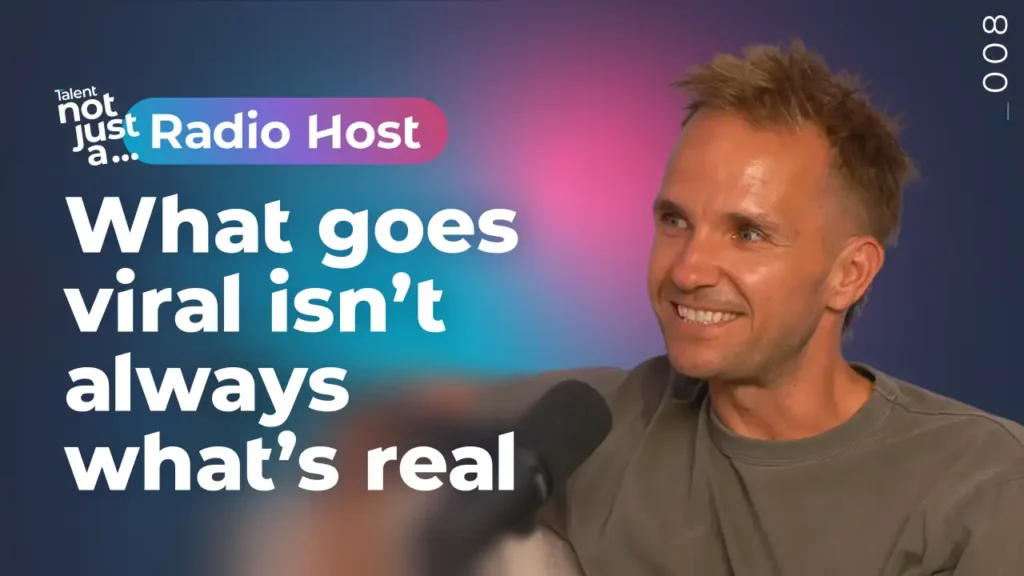
Episode transcript
Note: This transcript has been edited for clarity and readability while staying true to the spirit of the conversation.
Amanda: This is Not Just A…, the podcast where we get to know the person behind the job title. I’m your host, Amanda, and today we’re chatting with radio announcer Kent Small. We talk about his journey to becoming one of Australia’s most loved radio hosts, how he prepares to interview some of the world’s biggest stars, and how he tackles feedback. But more importantly, we chat about who he really is behind the job title. Let’s get into it.
Amanda: Kent “Smallzy” Small, welcome to the podcast.
Kent: Oh, it’s the most exciting podcast I’ve been wanting to do forever. I’m so glad I’m here.
Amanda: I’m so excited you’re here. And people don’t know this, but we’re friends outside of work.
Kent: We are, and we do have to make that disclaimer up the top, don’t we? Make sure everyone knows that this is going to be soft. She’s not going to ask any spiky questions.
Amanda: I might. You never know. Because I know you.
Kent: You do. You know where my bodies are buried.
Amanda: We did Europe together.
Kent: We did.
Amanda: We’ve had lots of fun.
Kent: I know your parents, so if you do me wrong, I’ll call them.
Amanda: Fair. So, this is about getting to know the person behind the job title. You’ve been in radio for 23 years, which is amazing. But I want to know… before radio, what were you doing? What was driving you then?
Kent: I was in high school. And honestly, people need to know I’ve done nothing else except radio my entire career. Apart from a great retail job stacking CDs at Dick Smith.
Amanda: Oh great.
Kent: If anyone listening remembers CDs… those were the things you put in a player before streaming. My casual job was putting CDs into those hard plastic lock cases so no one would steal them.
Amanda: Yeah, because they were like $20 or $25, and everybody wanted them.
Kent: Absolutely.
Amanda: So, did you always want to get into radio?
Kent: Since I can remember. I used to listen as a kid, making mix tapes, recording songs off the radio. But what was different for me is that I was more interested in what the people were saying between the songs. All my friends were like, “Who cares? Just play the music.” And I was like, “No, I actually want to hear what the DJ has to say.” I loved the IDs and sweepers, the production between tracks. I’d record that just to listen back. So, I’m a radio nerd.
Amanda: So, you were born to do it.
Kent: Yeah, I think so.
Amanda: What was your first radio job?
Kent: The first contract I signed was for launching a radio station on the Central Coast of New South Wales when I was 19. But my first ever on-air shift was Nova Sydney, midnight to dawn.
Amanda: Midnight to dawn! What time were you coming into the studio?
Kent: Back then, I was so excited I’d get there at like 9pm, three hours early. If I was doing it again now, I’d probably roll in 10 minutes to midnight, just to make sure the mic worked and the coffee machine was on. But in those days, I was there so early just to talk three or four times an hour.
Amanda: That’s so good. And honestly, if you’re starting out in radio industry, you’d definitely be in two hours before.
Kent: Minimum!
Amanda: And now you’ve signed with KIIS, with ARN.
Kent: I have.
Amanda: So exciting. And Ed Sheeran launched it, and so did Niall.
Kent: She’s done her research!
Amanda: I have. How was that? It was a big moment.
Kent: Probably the most exciting thing I’ve been part of. Leaving my old job was huge, and announcing I was leaving but not being able to say where I was going… I just had to let people think, “Oh, he’s had a great run.” Then in the lead-up, pulling everything together, reaching out to friends, figuring out what we could do… the photoshoot… There was so much.
Amanda: And your beautiful dog Alfie, I saw some photos.
Kent: Yes, my dog crashed the photoshoot. She looked a million bucks. Total superstar. I was going to bring her in.
Amanda: I’m quite sad you didn’t, but I know you were at a movie premiere.
Kent: Yeah, I was at something for a Bradley Cooper interview. You know, these are the things I have to do.
Amanda: If you could tell your younger self something, what would it be?
Kent: The biggest thing would be to enjoy the moment more and be present. On reflection, in the early part of your career, you spend so much time racing up the ladder, climbing to the next thing… You don’t spend enough time being in the moment. When I look back at my early career, it was like the wild west. You could get away with so much because the stakes were smaller. Now it’s still fun, but there’s a lot more on the line.
Amanda: What feels like it’s on the line now?
Kent: The consequences are bigger. Embarrassing yourself in an interview at 19 on a small night show is vastly different to sitting in front of Bradley Cooper next week and making a mistake. There are more people invested. People want outcomes. It moves quickly. So, the advice is: enjoy the moment. Don’t worry about what’s coming next.
Amanda: Most memorable celebrity interview?
Kent: Any of the big movie stars stand out. Tom Cruise is one of the most memorable. So much gets said about him, but he’s one of the few Hollywood stars I’ve watched take the time to meet every single fan on the red carpet. He spent like three and a half hours saying hello to people. Then on the press line, where actors sometimes skip outlets… he spoke to everybody. Absolute professional.
Amanda: That’s so interesting. And different compared to many actors now, especially for somebody who’s been doing it for so long.
Kent: Totally. I always say a lot of actors could learn from Tom Cruise. He does things that technically he doesn’t need to do, but everyone walks away going, “God, he’s a good guy.”
Amanda: Well, that’s like Ed Sheeran and Taylor as well. Ed still does quite a bit of press.
Kent: Yeah. And I think press serves two purposes. For an actor or an artist, the idea of doing interviews is to talk to people who aren’t necessarily your fans. With social media, some artists don’t like doing interviews anymore because they feel like they can speak directly to their fanbase. And they can, 100%. But for a lot of artists, they’ve already captured their fans. The reason you do press is to reach people who aren’t in your camp yet. Taylor can put a tour on sale, Ed can put a tour on sale, and fans will snap up tickets. But that doesn’t automatically mean you can sell a stadium off an Instagram post alone. You need other avenues to activate people who aren’t already invested. That’s what interviews do.
Amanda: Absolutely. Alright, we’re moving on to the personal stuff now.
Kent: Oh, okay. We’re going deep.
Amanda: We are. Who are you when nobody’s watching?
Kent: This is going to sound cliché, but I genuinely believe I’m the same person. You can judge me on that, because I know you speak to a variety of people, and a lot of people put on their corporate hat when they walk into work. They leave their family, their desires, their real self at the door. I’m lucky that I do a job where they just want me. They want me as I am. And I actually find it difficult to conform and do what I’m told. You know Zach, my executive producer… he’ll tell you that if you try to tell me what to do, I’m like, “Whoa, hang on a second.” I’ve spent 20-something years doing what I want to do. It’s an art to manage people like us, because we’re dumb, truthfully. We’re a bit like golden retrievers. We’ve got lots of energy, but you have to hoodwink us with a treat to get us to do what we need to do. You have to convince us it was our idea.
Amanda: And what’s your treat?
Kent: Praise. Just tell me I’m good, and I’ll do whatever you want.
Amanda: We did talk about love languages in Europe.
Kent: Yes. Does your audience know the five love languages?
Amanda: Maybe we should tell them.
Kent: You told me so you need to do it.
Amanda: The five love languages are how everybody likes to be loved and how they express their love. They’re words of affirmation, physical touch, acts of service, receiving gifts, and quality time.
Kent: We all have all five, but they show up differently. Sometimes in a relationship, everything seems right, but you’re not feeling loved. That might be because your love language is words of affirmation, but your partner shows love through gifts or acts of service. So you don’t interpret it the same way, even though they are showing love. It’s important to understand how your partner shows up.
Amanda: Great. I’m learning tips for interviewing here, I needed to explain to the audience!
Kent: Do you know what the best part is? You asked me who I am when I’m not at work… This is literally who I am. I jump in at dinner and help someone tell a story.
Amanda: That’s why you’re so good at what you do. So, can you share a story from your work that captures how being fully yourself has made you successful?
Kent: People always say I do really good interviews, or people love listening to my conversations. And I think that’s genuinely because I just enjoy talking and getting to know someone.
Amanda: You’re curious.
Kent: Thank you. Curiosity is a big character trait of mine. So is justice.
Amanda: Tell me about justice.
Kent: Yes. Justice is high for me. I get emotionally hooked when I feel like there’s injustice happening. Someone’s been misled, lied to, manipulated, unfairly sacked… I lean into that. If I see you being critiqued for something that isn’t true, I’ll jump in. That’s how justice shows up. Some people won’t respond in the moment. They’ll accept it. I try to save people, sometimes to my own detriment.
Amanda: Is that only for people you care about?
Kent: A lot of people. Even if someone was verbally abusing your assistant here, and it was unfair, I’d step in. The thing is, overusing or underusing any trait has consequences. Underusing justice means unjust things happen. Overusing it, you become a fighter, always correcting the record. You can find injustice everywhere.
Amanda: Did you ever want to go into law?
Kent: I did, actually, in high school.
Amanda: Did you do debate club?
Kent: I did. What do they call it now, ATAR? Back then, I got the UAI.
Amanda: Not a UTI.
Kent: That’s another thing altogether. Keep that in, that’s hilarious. Don’t take the comedy out! My UAI said, “You have no future.” So people know, I met Amanda in music and she met me in music, where people have no futures.
Amanda: What’s something you’re deeply passionate about that would surprise people?
Kent: Politics.
Amanda: Yes, I knew that.
Kent: I love politics. It’s the yin to the yang. I spend my work life talking about what Taylor had for breakfast, and then in my personal life going, “Did you see what happened today? What’s Trump done? What’s Albo up to?” It’s total opposite.
Amanda: Do you think that ties into the justice side?
Kent: What I know about politics is there’s no justice in it whatsoever. Politics is manipulation, game playing, leverage. But I enjoy debating. I’m strong-willed and have an opinion on most things, probably to my detriment. I’ll have a position on something I maybe shouldn’t even have a position on.
Amanda: But you make great conversation.
Kent: My theory is I know 10% about 90% of things. I’m no expert, but I have a broad base. Then I dig deeper with curiosity. I would talk about literally anything with anybody.
Amanda: And you read and watch the tele.
Kent: I don’t really like reading. Is that controversial? You know what has blown my mind. When people say they enjoy reading, I don’t understand it. Good food and chocolate is what I enjoy. Is reading the same feeling?
Amanda: For me, it’s switching off. I can immerse into a story, escape the world.
Kent: I don’t understand that experience at all.
Amanda: That’s fine. I also do enjoy eating chocolate.
Kent: Okay, great. Reading is not something I enjoy. Chocolate is what I enjoy. But I will read, I’ll force myself to read. I can read, obviously. I just don’t enjoy it. And I don’t reckon I’ve ever finished a book.
Amanda: Really?
Kent: I went to Bali last week and took a book with me. I got about three quarters of the way through it… and then I was done. I didn’t even care what happened at the end. I’ve got the gist of it.
Amanda: That is wild. What was the book?
Kent: The Parasitic Mind. It’s basically about how bad ideas go unchallenged — in universities, on social media, in business — and if they don’t get challenged, they start to become “truth,” even when they’re not. It’s a bit like feelings versus facts.
Amanda: People get those mixed up, don’t they?
Kent: Exactly. How you feel about a situation isn’t necessarily the truth of the situation. But if we believe that how people feel is reality, then feelings become facts. Before you know it, it’s a slippery slope. It can change a culture in a business. People can start believing the environment is a certain way, even if it’s not. And if that idea is treated as truth, it can damage the whole fabric of a workplace.
Amanda: There’s two sides to every story.
Kent: There’s two sides to every story… and the truth is usually somewhere in the middle. Just clarifying that for the audience.
Amanda: Thank you. If you could be known for something completely different than what you’re known for now, what would it be?
Kent: That makes me feel a bit vulnerable.
Amanda: This is about vulnerability — the person behind the job title. So we’re going there.
Kent: Okay. I reckon there was a part in my early years where I would have loved to have been an actor. But when I tell people that now, they scoff. Like, “As if you could be an actor. No one could tell you what to do.” And fair — because I don’t love being told what to do. But I feel like that’s a learned behaviour. It comes from years of having to be who I am in radio. People don’t realise there’s who I am, who the business wants you to be, who the listeners expect you to be, who clients want you to be… And through all of that, you have to remind yourself of who you actually are. Everyone tries to push you and mould you into the version of you they think they want. In your early years, you take advice on. But sometimes you end up in a situation where you think, “I didn’t even want to be here. Someone pushed me here. Someone sold me the dream.” And then when it doesn’t go to plan, you’re left licking your wounds, ego bruised, going, “How did I get here?” And you realise it’s because you didn’t stand firm in the moment and say, “No, that’s not what I want.”
Amanda: Not all feedback is valid feedback, right? Or do you think it is? And what I mean is… should you take feedback from somebody you would never ask for feedback from?
Kent: No, because I don’t think you know where the gems are. Just because someone isn’t your person doesn’t mean there isn’t something valuable underneath what they’re saying. What I always do with feedback is filter it through: who are you, what’s the feedback, what’s the intention, are you in my camp?
Amanda: Yeah.
Kent: Like, if I gave you feedback on your podcast, you could argue, “You’re not really the audience, so thanks but I’ll pass.” But you might also think, “Hang on, he’s a friend. He wants me to succeed.” So maybe you can mine something useful from it.
Amanda: I’m definitely going to be asking you after this.
Kent: Absolutely. We could do a full air check. That’s what we call it in radio — we go back, listen through, and give notes.
Amanda: I would really love that. This is the first time I’ve ever done this.
Kent: You’re doing great, sweetie. Honestly, I would listen to anyone’s feedback. The thing with feedback is you have to leave your ego at the door. Feedback only hurts because your ego is hurt.
Amanda: I like that. Okay… it’s getting really deep.
Kent: I haven’t even scratched the surface yet. What more do you want?
Amanda: Alright, my next question — what’s a lesson you’ve learned outside of work that actually made you better at your job?
Kent: The biggest lesson I’ve learned is that everybody is going through their own shit. Don’t compare yourself to what you think someone else is living. Imagine all of us are icebergs. We only show the world the 10% above the water. But 90% of an iceberg is underneath the ocean — you don’t see it. So we walk around only seeing the top 10% of people. But you compare your hidden 90% — your fears, insecurities, doubts — to the 10% you see of someone else. And you have no idea what’s going on underneath them.
Amanda: That’s so true.
Kent: Once you realise that, you stop comparing yourself. You stop diminishing your self-worth based on what you think is happening over there. I actually just came out of this new Bradley Cooper movie, which is coming out next year. It’s basically about a husband and wife who get divorced and they’re navigating their post-divorce life. And I was watching it thinking… as a kid from a divorced family, you just go, “Oh my God.” Your parents really were just doing the best they could with what they had. They’re no different to us. I remember when my parents were in their 40s and I thought they had it all together. And now I’m like… no one has it all together. We’re all human.
Amanda: Yeah. So how has that helped you with work, when we circle it back?
Kent: Because when you realise that, you stop comparing yourself to everybody. You stop competing against what you think someone else has. If you’re having an argument with a colleague, or a disagreement, or someone’s making you feel a certain way… You go, “They don’t have it together either.” I’m not going to diminish my self-worth based on what I see over there. And I think in the business world, a lot of people get caught up in office dramas. Watching someone they perceive to have more opportunities, more recognition… “It’s always Suzy in Accounts, she always gets this.” But you don’t know what her opportunities are. You don’t know what’s underneath her iceberg. You can only focus on you.
Amanda: I like that. You don’t know what’s going on underneath their iceberg. I think social media has also done something really strange. It started as a highlight reel…
Kent: I hate social media. It’s disgusting. It’s performative. Think about it — you’re swiping through and it’s like… Hot, sexy, ripped, rich, Ferrari… And you’re thinking, “I don’t have any of that. I’m not worthy.” That’s you judging your 90% against someone else’s 10%. But then there’s this flip, where you have the extremes happening. “My life is a disaster. Everything’s falling apart.” That’s performative too. Think about the most vulnerable moment of your life. Can I be personal?
Amanda: Yeah.
Kent: Think about one of your cats. If one of your cats died… are you whipping your phone up and filming yourself reacting?
Amanda: Definitely not.
Kent: Because you’re a normal human. But social media is full of people doing exactly that. The extremes on both ends. “I’ve just been in a car accident, let me film this.” Or people filming themselves while their dog is being put down. My TikTok feed is full of people filming themselves in that moment. Who is filming that and putting it online for likes and clout?
Amanda: Yeah… that side of it is bad.
Kent: Because true social media, if it was actually real, would be like… “I went to work today. It was average. I’m going home.” And then you and I would look at that and go, “Oh, their day was as mundane as mine.” But that’s not what’s on social media. You’re either supposed to feel shit because my life is so exciting… Or feel relieved you’re not that person whose life is falling apart. It’s clout-chasing on both ends.
Amanda: So you don’t think there’s a middle ground?
Kent: No way. Middle ground is boring. No one engages with the middle ground.
Amanda: Maybe we can start there now.
Kent: I would love to, but look at the news. Look at what goes viral. The highs or the lows — not the normal. And it’s the same with celebrity interviews. When we interview a celebrity, we want a great conversation. I always pride myself on not being the guy chasing a headline. My intention is to make them feel comfortable. Maybe they’ll offer something genuine. But how many news articles get written about… “Oh, they did an interview promoting their movie and everything is great”? None. The most salacious, scandalous stuff is what clicks. And it’s getting worse. You watch photographers on a media wall — if someone tumbles, they go wild. That’s the photo they want. They don’t want someone looking normal.
Amanda: It’s sad, isn’t it?
Kent: Yeah. Sadly, we’re nowhere near normalising social media or putting a healthy lens on it.
Amanda: Okay… we’re going to change tack now. What would people be most surprised to learn about what your job really involves day to day?
Kent: I think people would be surprised how much thought and planning goes into it. I was in a taxi the other day and the driver was like, “Are you Smallzy from Nova?” And I said, “Yep, but not next year — I’ll be Smallzy from KIIS.” And he goes, “This must be an easy job. You just show up and talk.” And I’m like… no. People would be surprised how many people behind the scenes are working on the show. It’s not just me behind a microphone. There’s an army of people pulling everything together. It’s a team effort.
Amanda: I know, because I worked with you, and I worked with Zach. And Zach would be in at least four or five hours before.
Kent: Minimum. He’d be in well before, managing a whole team. Everyone has their slice of the pie that adds up to the show.
Amanda: Alright. What is your hidden talent?
Kent: I was going to text you beforehand and ask what you meant. Like, party trick talent? Or like, I’m a maths whiz?
Amanda: No filter. Anything. Someone told me today they can do animal noises.
Kent: Really?
Amanda: Yeah, and it was actually really good.
Kent: Okay. Hidden talent… I mean, this won’t be able to be proved right now, but next time we can. I can recognise a song from one bar. Like one note. I’ll be able to give you the title and artist straight away.
Amanda: Wow. Like the one-note challenge guy.
Kent: Exactly.
Amanda: Okay, we’ll do it.
Kent: There has to be a rule though. It can’t be any weird progressive music you’re into. Because Amanda and her husband are into some strange stuff sometimes, and I’m like, “I don’t know the merry-hatted two-hat band from Newtown.” I deal solely in top 40 hits.
Amanda: Deal. Okay, here we go.
Kent: Go.
Amanda: [plays a song]
Kent: Oh no… I don’t know that at all.
Amanda: Stop it! It’s Lady Gaga’s “Alejandro.”
Kent: That’s a deep album cut! Give me another.
Amanda: Okay. [plays a song]
Kent: Oh! Young Money, Nicki Minaj… Justin Bieber — “Beauty and a Beat.”
Amanda: Yes!
Kent: Thank you very much. Do another.
Amanda: Okay. [plays a song]
Kent: Christina Aguilera — “Genie in a Bottle.”
Amanda: Yes. Okay. [plays a song]
Kent: Katy Perry — “Teenage Dream.”
Amanda: Yep. Last one. [plays a song]
Kent: Dua Lipa — “New Rules.”
Amanda: Well done. So good.
Kent: That’s my hidden talent. Who put me under pressure? I’m sweating up a storm.
Amanda: Thank you so much for joining us on the couch.
Kent: Are we done?
Amanda: We’re done!
Kent: How great was that? You’re really good.
Amanda: Thank you.
Kent: Thanks for having me. Appreciate it.
Enjoyed this episode?
Explore more conversations with inspiring leaders and innovators on our podcast or subscribe to our YouTube channel for the latest episodes.
We know that talented people know talented people. If you’d like to talk to us about how we can support your business, get in touch.