
Episode 7 – Not Just a Sports Agent with Alex Williamson
Episode 7 – Not Just a Sports Agent with Alex Williamson
Episode transcript
Note: This transcript has been edited for clarity and readability while staying true to the spirit of the conversation.
Amanda: Welcome to Not Just A, the podcast where we get to know the person behind the profession. Each episode, we sit down with someone interesting to hear the stories that shaped who they are beyond their job title.
Our first guest is Alexandra Williamson, a pioneering sports agent in Australia for female athletes. Alex has worked with many Olympians and Matildas. In this episode, she shares her time working for Australia’s first female Prime Minister, Julia Gillard, and her experience working with the Matildas during the Women’s World Cup here in Australia.
Let’s get into it.
Amanda: Alex, welcome. Thank you so much for joining us.
Alex: Thank you.
Amanda: I wanted to kick things off by going back to who you were before you became a sports agent. I’d love to hear your story and background.
Alex: I’ve had a pretty interesting journey. If someone had told me 10 or 15 years ago that I’d become a sports agent, I wouldn’t have believed them.
I originally studied PR and marketing and worked in a few junior communications roles. Then I was given an opportunity to move to Canberra to work for Julia Gillard. At the time, she was Deputy Prime Minister, and I came on as her media assistant.
I was incredibly fortunate to work with her for five and a half years, including when she became Australia’s first female Prime Minister. It was an extraordinary time in history.
After that period, which people often say feels like “dog years” in Canberra, I moved to Football Australia. I worked there as Corporate Events Manager for seven years. During that time, I saw the incredible growth of the women’s game and was part of the team that won the bid to host the 2023 Women’s World Cup.
Amanda: Do you feel working with Julia helped shape you as a sports agent?
Alex: Absolutely. I saw firsthand the pressure and expectations placed on women in the public eye — what they wear, how they speak, how they behave. You see the same expectations placed on female athletes, just in a different setting.
That perspective has been one of the biggest takeaways I’ve brought into my work now.
Amanda: What drew you to PR and marketing when you finished school?
Alex: I graduated in the early 2000s, when PR was the buzzword and a lot of young women wanted to work in publicity. It sounded glamorous, but in reality, it was a lot of hard work and underpay — at least back then.
I was drawn to the idea of it being exciting and creative, even though the reality was very different.
Amanda: As a former PR person myself, I relate. My first proper PR job involved selling dog biscuits — and back then, people didn’t really spend money on their dogs.
Alex: Exactly. Fast forward to now and it’s a whole industry.
Amanda: This podcast is about the person behind the title, so who are you when nobody’s watching?
Alex: That’s a hard question. I really had to think about it.
Outside of work, I’m a mum first and foremost. I have two young children — a six-year-old and a four-year-old — so life is very full.
I’m also the eldest of five siblings, which means I’m very used to wrangling people. I’m an aunt to six nieces and nephews, nearly seven, and I come from a very close family. Family is at the core of who I am.
Outside of that, I love binge-watching TV, reading when I can, and just trying to find moments to switch off.
Amanda: What are you watching at the moment?
Alex: I’m binging The Gilded Age. It’s a period drama about old money and new money in New York. It’s a great binge.
Amanda: What does a day in the life look like for you?
Alex: I’m usually up around 5:30 or 6:00. My son loves an early start. A lot of my athletes are overseas, so I’ll catch up on messages that came in overnight.
Then it’s school lunches, getting the kids out the door, and heading into the office. Every day is different. Some days I’m pitching athletes for sponsorships or media opportunities. Other days I’m attending events, photoshoots, or competitions.
By late afternoon, it’s back into mum mode. My son has autism, so we also manage therapy appointments alongside swimming, dancing, and sport. After dinner and bedtime, I usually jump back on the laptop to catch up again.
It’s definitely a juggle.
Amanda: What’s something you’re deeply passionate about outside of work?
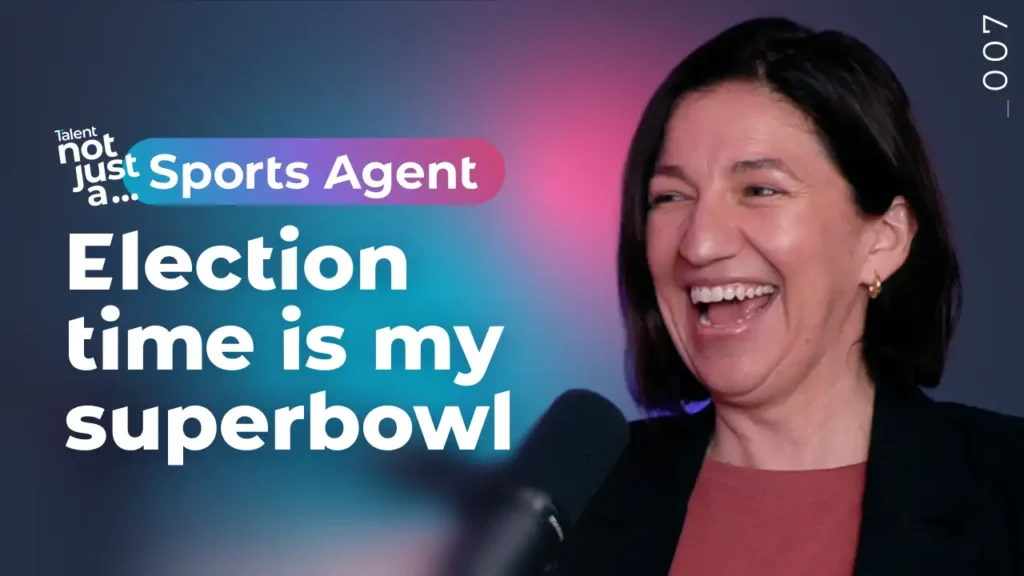
Alex: Politics. Election time is my Super Bowl. I love Australian and global politics — especially the personalities, the strategy, and the visual storytelling.
When I worked for Julia Gillard, I was an advancer, which meant curating the look and feel of events and media moments. That visual side of politics still fascinates me.
Amanda: Where were you when Julia Gillard delivered the misogyny speech?
Alex: I was working at Football Australia and watched it on TV in the office. It felt like everything she’d been thinking for years finally came out in that moment. You could tell it wasn’t scripted — she put her notes down and just spoke.
Amanda: What were the top three things you learned working for her?
Alex: Patience, respect for staff, and preparation. She was under enormous pressure but never raised her voice. She was always exceptionally prepared and deeply aware of how decisions affected everyone around her.
Amanda: If you could be known for something completely different, what would it be?
Alex: Supporting women to succeed on their own terms, and being a great mum. Those are the two things that matter most to me.
Amanda: How far do you feel women’s sport has come, and what still needs to change?
Alex: It’s come a long way, but there’s still so much to do. I remember Matildas games with a few hundred people in the stands — now they’re selling out stadiums.
The next step is real investment and parity. When female athletes across sports become household names and are paid fairly, that’s when we’ll know real change has happened.
Amanda: What would people be most surprised to learn about your job?
Alex: How much emotional support it involves. It’s not transactional. I manage 17 women, and at any given time, some are thriving and others are struggling.
Being present for all of that — the highs and the lows — is a huge part of the role.
Amanda: Final question: what’s your hidden talent?
Alex: Music trivia. Especially ‘80s music. If you play a song, I’ll know it instantly.
Amanda: That’s a great place to end. Thank you so much for joining us and for sharing your story.
Alex: Thank you.
Enjoyed this episode?
Explore more conversations with inspiring leaders and innovators on our podcast or subscribe to our YouTube channel for the latest episodes.
We know that talented people know talented people. If you’d like to talk to us about how we can support your business, get in touch.