
Episode 6 – Not Just a Sailor with Jason Waterhouse
Episode 6 – Not Just a Sailor with Jason Waterhouse
Episode transcript
Note: This transcript has been edited for clarity and readability while staying true to the spirit of the conversation.
Amanda: This is Not Just A… podcast where we get to know the person behind the job title. I’m your host, Amanda, and today we’re speaking with professional sailor Jason Waterhouse. We talk about his encounters with pirates, his Olympic experiences, how he manages injuries in the sport, and—more importantly—who he is outside of work. Let’s get into it.
Amanda: Thank you so much for joining us.
Jason: Thanks for having me. I’m excited to be here.
Amanda: My first question: what was your childhood like?
Jason: I had a unique childhood. My parents were very passionate sailors—not professional, but they loved the sport. I grew up on Sydney’s Northern Beaches, and when I was young, we bought a yacht and sailed around the world. I spent four years of my childhood on a boat, exploring the world. It was an amazing way to see so much and build strong bonds with my parents and my sister. My love of the ocean naturally evolved into a love of the sport.
Amanda: When did you start competing?
Jason: My first competition was with my sister on Pittwater when I was about eight. I hated it—I was scared and just wanted to get off the boat. But I kept at it, got more comfortable, and when I was 14, I qualified to represent Australia in the UK. That was my first taste of competing internationally, meeting people from all over the world, and I was hooked. That lit the candle for me.
Amanda: Did you feel pressure competing so young?
Jason: Not really until the final race of that first regatta—we choked, went from a silver medal to off the podium in one race. But that early exposure to pressure was valuable. I kept competing internationally and eventually won gold in Brazil on my fourth attempt.
Amanda: What was school like for you?
Jason: Before we went cruising, I was good at school—top three in my class and considering a selective school. But remote schooling while sailing around the world definitely set me back. When I returned, I struggled to sit still after seeing so much. My sister did great academically, but I leaned into sailing. My crew, Lisa Darmanin, was incredibly academically strong—she could juggle both. I knew I wanted to put everything into sailing, and I was lucky to have the support to do that.
Amanda: Sailing around the world sounds incredible—but also risky.
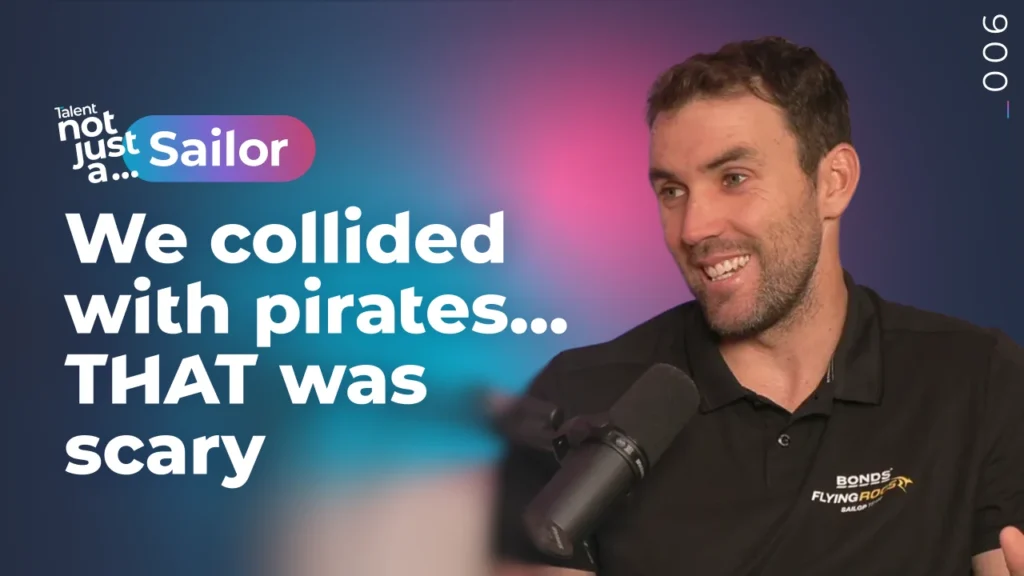
Jason: It’s more adventure than danger, but adventure always carries risk. We had a pirate encounter off Colombia in 2003. We were sailing from Panama to the Galapagos when our boat started sinking and we had to divert to Ecuador. That route took us near Colombia, which we knew was dangerous. In the middle of the night, a pirate boat tracked our navigation lights and collided with us. Mum and Dad managed to deflect the boat, we shut off all lights, and disappeared into the darkness. It was terrifying. But safety and technology have improved a lot since then.
We also had hurricanes near San Diego and Canada—storms at sea can be frightening. You do your best to navigate around them, but sometimes you just have to go below deck and ride it out.
Amanda: Who are you when nobody’s watching?
Jason: I’m pretty relaxed and easy-going. I love getting away from the city—surfing, heading inland, spending time in nature. I’d usually snowboard too, but injury risk means I can’t anymore. In SailGP, our team has six people, and we each have strict roles. I’m the flight controller—I manage the hydrofoils that lift the boat out of the water and help balance it. These boats hit up to 100 km/h, compared to 20–30 km/h on traditional yachts.
Amanda: You’ve done the Sydney to Hobart too, right?
Jason: Yes, and I’ll probably do it again this year. But mostly I’m a catamaran sailor—the Olympics, SailGP, and similar events are all on high-performance cats or monohull hydrofoils.
Amanda: What were the Olympics like?
Jason: Amazing. Rio was full of energy—crowds, family, atmosphere. Tokyo was the opposite because of COVID: no crowds, no family, lockdowns. I wasn’t bothered personally; I was grateful the Games still went ahead. But it was sad for Japan after all they invested. I was preparing for Paris but had to choose between continuing or taking an opportunity with the America’s Cup in Barcelona. My daughter had just been born, and it was the toughest professional decision I’ve ever made. No regrets, though.
Amanda: Favourite race?
Jason: The Rio Olympic medal race was awesome. But SailGP has been incredible—we won three championships in a row in San Francisco. It’s a wild venue: strong winds, strong currents, fog. It’s challenging but rewarding.
Amanda: Best place you’ve been while cruising?
Jason: French Polynesia, but not the well-known spots like Tahiti. The remote atolls a few hundred miles away—untouched, isolated, stunning. The nature there is humbling.
Amanda: What drives you?
Jason: Family. Becoming a father changed everything. Growing up in such a tight-knit family made me want the same for my own. I never appreciated how brave my parents were taking a four-year-old into the middle of the ocean. Now, with my daughter, I overthink everything. I want to give her similar experiences, but I’m still finding the courage.
Amanda: What else motivates you?
Jason: I try to make people’s days better—friends, strangers, anyone. My dad’s incredibly positive and energetic, and I try to bring some of that into my interactions. I travel constantly—20 cities this year—so keeping that attitude helps.
Amanda: How often are you on the road?
Jason: SailGP has 12–13 events a year, each about a week long. That’s about three months on the road, not counting travel and jet lag. When I get home, I’m straight into dad duties—my wife handles so much while I’m away.
Amanda: What does training look like?
Jason: Like Formula One, SailGP caps training to control budgets. We only get one practice day before racing. To improve, I sail smaller boats—like when I race the Sydney to Hobart—to keep upskilling. I’m in the gym six days a week to manage weight, strength, and injury prevention.
Amanda: What’s the biggest difference between SailGP and Formula One?
Jason: All SailGP boats are identical, so racing comes down to the sailors’ skill. Formula One depends heavily on the car. We’ve had three different winners in the last three events, which keeps it exciting.
Amanda: What’s the biggest lesson from outside sailing that applies to your work?
Jason: Communication. An early coach taught us to “put older heads on young bodies”—mature early, stay composed, communicate well. Working with multicultural teams across Austria, New Zealand, Switzerland, Japan—you realise how important clear, unemotional communication is.
Amanda: How different is it communicating with women versus men in the sport?
Jason: Sailing with my cousin Lisa taught me that women often need to feel good to go good, whereas men often go good to feel good. Not better or worse—just different. Learning how to communicate with Lisa improved how I communicated with male teammates too.
Amanda: Can you share a story about teamwork?
Jason: Before the SailGP finale in San Francisco, I had a terrible training day—crashed the boat, lost confidence. That night at dinner, I opened up and said, “I feel like I’m playing defence.” Because we had strong trust, the team helped me work through it. The next day we turned everything around. That vulnerability came from years of building trust. In larger organisations, like when I worked with Alinghi Red Bull Racing, that trust is harder to build.
Amanda: What’s something people don’t see behind the scenes?
Jason: The travel. I spent six days in the air this month alone. Managing jetlag, nutrition, and sleep is a huge challenge. Injury prevention is another big one—I’ve had injuries since I was 14, and managing them is almost a full-time job. I spend a lot of time on mobility and rehab. The psychological side—fear of reinjury—is even harder. I worked with psychologists and an amazing physio, Ashley Woolf, who genuinely helped save my career.
Amanda: Do you have any hidden talents?
Jason: Not really—I’m terrible at most hobbies. But I do have unusually long arms—about 30% longer than my height. It actually helps with sailing, reaching things, and probably would’ve made me a good swimmer or basketballer. Bit wasted now!
Amanda: Thank you so much for joining us.
Jason: Thanks for having me.
Enjoyed this episode?
Explore more conversations with inspiring leaders and innovators on our podcast or subscribe to our YouTube channel for the latest episodes.
We know that talented people know talented people. If you’d like to talk to us about how we can support your business, get in touch.