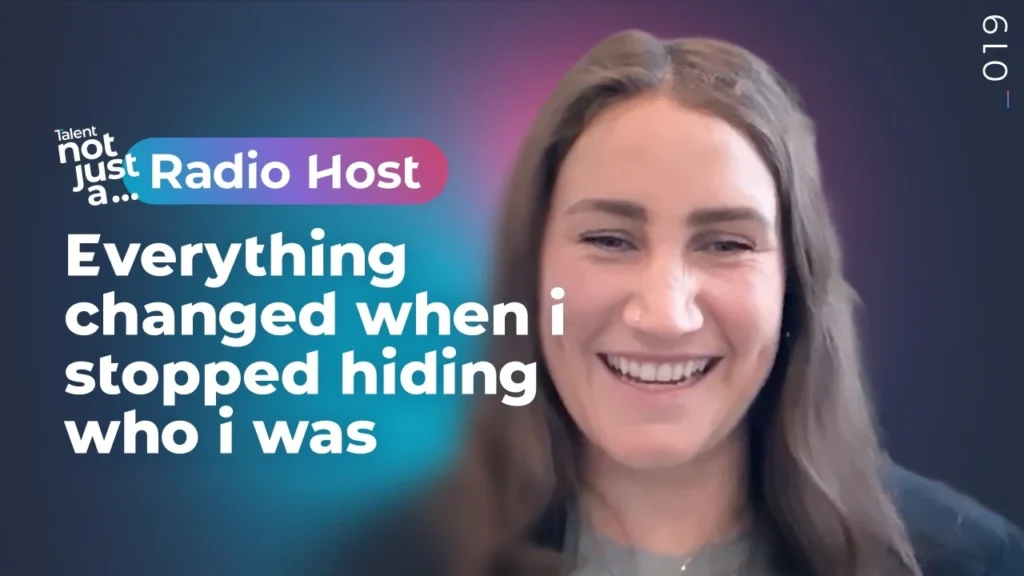
Episode 19 – Not Just a Radio Host with Bree Tomasel
Episode 19 – Not Just a Radio Host with Bree Tomasel
Episode transcript
Note: This transcript has been edited for clarity and readability while staying true to the spirit of the conversation.
Amanda: This is Not Just A…, a podcast where we get to know the person behind the job title. I’m your host, Amanda, and today we’ll be chatting to New Zealand radio announcer Bree Tomasel.
We chat about overcoming the fear of failure to pursue her dreams, navigating her identity in radio, and why deep human connection drives everything she does.
Let’s get into it.
Amanda: Bree, welcome to the podcast. It’s so great to have you on with us.
Bree: Mate, it’s so great to be here. Thanks for having me.
Amanda: You are Aussie born and bred, but you living in New Zealand currently.
Bree: Yes. Got deported from Australia eight years ago now.
No, I’m just kidding. I’m joking.
Yeah, I moved to New Zealand about eight years ago. God, that seems like a lifetime.
Amanda: So you were there during the Covid lockdowns, so you couldn’t come back to Australia.
Bree: Yes, I sure was. That was a really, really difficult time for me and a lot of people, not being able to see your family or your friends.
I think the hardest part was not knowing when you were going to get to see those people again.
I don’t like to think about those times very often, but yeah, very difficult.
Amanda: You’ve had an incredible career here in Australia and then you moved to New Zealand. What were you doing before you became a radio announcer, what was driving you then? Give me the back story.
Bree: I wasn’t doing much. I was doing bits and pieces. I was going to uni, struggling to survive as a student.
I think really, back then, I’ve always been a people person. What was driving me was connection, human connection. And I think that’s honestly what still drives me to this day — that human connection.
Amanda: What made you want to get into radio? When was the first break? When was the moment when you realised “I love people, I want to chat to people, I need to get into radio”?
Bree: That’s such a good question.
I think I’d always been a huge radio nerd. I was the person that got invested into radio shows.
I remember when I was at boarding school, I would listen to Labby, Stav and Abby. It was Labby, Stav and Camilla at first, and then it turned into Labby, Stav and Abby. That was a part of my day. I felt like I had that connection with these people. They were a part of my day-to-day routine, and I just loved it.
I was always interested in it, but I never thought it was something that could be a reality for me. I never thought it was realistic to have a career in radio. I never thought that was something I could do.
As I was studying, I was at the University of Queensland doing a Bachelor of PR and Journalism, and it came to the end of my degree where they were like, “As part of your studies, you can go and do an internship somewhere, and that counts as points towards your degree.”
For me, someone with ADHD, I was like, sweet, if I don’t have to write an essay or do an exam, then I’m keen for that.
I remember saying to this guy who was pretty much the mentor for the internships, he was like, “What do you really like? What are you interested in?”
I was scared to say it because I was like, I must sound stupid, but I really love radio. That’s always been something I was really interested in.
It was him that gave me the confidence. He was like, “You should go try it. You should go and give it a go.”
I’ve never looked back, Amanda, since that day.
Amanda: I think there are a lot of kids out there who are probably nervous to say, “I want to go into acting” or “I want to go into singing or radio”. What advice would you give your younger self or someone who really wants to do something like that but is afraid to voice it?
Bree: I think, “Don’t let the fear of failure stop you from giving things a go.”
For someone like me, the fear of not having the courage to actually give something a crack was always bigger than the fear of failing at something.
So I think get your priorities right and in line, and look deep within you as to what really drives you.
For me, the biggest regret in life is not having the guts to actually go and give something a try.
Amanda: I can relate to that too, sometimes I look back and think, “I should’ve just done that.” So, Bree, who are you when nobody’s watching?
Bree: Oh geez. I think that’s easy for me to answer.
I am a massive homebody. I like my sweatpants and cooking nice food at home and hanging out with my partner and walking my dogs.
To be honest, just quite a slow-paced, relaxed kind of person. That’s what I really enjoy outside of my work.
I think it’s such a juxtaposition because that is nothing of what I’d describe my career to be. It’s everything but that.
So I think that’s what it really comes down to. I enjoy the complete opposite when I’m at home.
Amanda: I think it’s so interesting you say that because I’ve heard from many people who have very public careers, speak quite regularly and are very front facing. A lot of them say they need to recharge at home, be by myself, relax, put on some Netflix, hang out with my friends and partner. It’s really interesting.
Bree: I think a lot of us are very much introverted extroverts. That’s the best way I describe myself as a person, which a lot of people are quite shocked by. People who don’t know the real me are quite shocked to learn that.
But that’s exactly who I am — such an introverted extrovert.
Amanda: What are you watching at the moment out of interest?
Bree: Oh god, what am I not watching?
I just watched that series with Claire Danes, The Beast in Me.
Look out. She’s brilliant in it. It’s quite a dark show, but yeah, murder mystery type vibe. It’s fantastic. I would recommend.
Amanda: It’s going on the list.
Can you share a story from work that captures how being fully yourself, not just the professional version, has made you successful?
Bree: I think for me, Amanda, if I look back on — it’s so weird saying career. I always feel weird about saying that I’ve had a career, but I guess I’ve worked long enough in radio now where I can say that. But that is the imposter syndrome coming out, which I definitely struggle with.
I think where things really clicked was when I stopped hiding certain parts of myself.
Let me give you more context around that.
For me, I’m a queer woman and have been my whole life, I believe. But in radio, for a long time, there were parts I held back of myself. There were people in this industry that told me that was a good idea.
So I wouldn’t share dating parts of my life or who I was seeing and those particular parts.
There was a really big disconnect for me for a long time where I couldn’t quite figure out why I couldn’t get past that next step.
It was actually when I moved to New Zealand, and I promised myself that I wasn’t going to do that anymore, and that I would tackle whatever repercussions came from sharing those parts of myself.
To be honest, there were no repercussions. The repercussions were actually that I had deeper connections with my audience.
That’s when it all seemed to click and start flying for me, when I was completely and utterly myself, as corny as that sounds.
I think people can tell these days. All they want is someone who is genuine and honest. Obviously, those particular parts, some people won’t connect with, but for me, it just opened this door where I could truly be myself and connect with the audience.
Amanda: And do you feel the radio industry is changing now where they are more accepting and they want you to be fully yourself on air and off air, or do you think there’s more work to do?
Bree: I think there will always be work to do.
People in general, as human beings, we are quite judgmental. That’s how we operate.
But I think the big thing is you add in social media and video and all these different elements that have come into play in radio over the last decade, and there’s no real place to hide.
If you aren’t someone that is sharing all those parts of yourself, people will feel that. I never, ever want to be that person again.
The thing that I strive for the most is to be really honest and to share the good parts and the bad parts, because none of us are perfect. That’s what really drives that deeper connection, I think.
Amanda: Was it a complete weight off your chest when you were able to be real?
Bree: Massive. Huge for me.
I never made a big song and dance about it. I think in the past that’s kind of what it’s been, but for me, it is a part of me, but it’s not all of me.
That’s how I tackled it on air. I would say someone’s name or say “her” instead of “him” or things like that.
That’s me as a person. I don’t want a big song and dance made about something. I just want to be me, and I just want it to be the exact same as my co-hosts, where they share stories about those parts of their life.
That was really important to me when starting to share those parts of myself.
Amanda: I think with social media and the younger generations coming through, they want to know the real people behind the brands, the microphones, the TV cameras. There’s no bullshit with them.
Bree: Oh, those bloody Gen Z, Amanda. They want to be all up in your business, don’t they?
That’s where I truly feel comfortable now. Fifteen years ago, that wasn’t me. It was because I was really struggling with my own identity and accepting myself and who I was.
That came out through the microphone.
These days, I’m kind of like, this is exactly who I am. I know who I am, and if you want to accept that, then great. But if not, then that’s okay.
Because I understand that in life, not everyone is going to be my cup of tea, and I’m not going to be everyone else’s cup of tea.
Amanda: What’s something you’re deeply passionate about that might surprise people who only know you professionally?
Bree: Like I said before, deep human connection is what I’m really passionate about.
I think that comes out in different parts of my life, but that’s something that really drives me deep down. I’ve always been interested in that, getting to the nitty gritty of who someone is.
I’m not a big surface-level conversation person. I hate small talk. It’s not for me.
But getting into those real deep connections and finding out why someone is the way they are — I love that. That’s what really drives me, and I’m passionate about that.
Amanda: Do you read books on psychology? Would you ever go back and study for fun?
Bree: I’m never going back to study, Amanda. That was hell on earth for me.
But I am really interested in it. I read a lot about different parts of psychology and why humans work the way that they do.
Getting my ADHD diagnosis a few years ago was super interesting for me, and I love learning about how my brain works so differently to other people. I love that stuff.
Actually, just off the top of my head, I learned something really interesting the other day.
You know when — and I feel like we’ve all had this in our life — you wake up and you’ve slept through your alarm?
I read this really interesting study that was talking about how, if you’re in REM sleep, and say your alarm goes off and you wake up and turn it off and go back to sleep, then you wake up later on and you’re like, “What the hell? My alarm didn’t go off.”
When you’re in REM sleep and you go back into REM sleep, your brain actually gets amnesia and you can’t remember waking up.
Isn’t that wild?
That’s why you should set multiple alarms.
Amanda: How much REM sleep are we supposed to get each night?
Bree: That’s a great bloody question.
I was the other day looking into getting one of those Oura rings or Ultrahuman rings or whatever they’re called.
I feel like if you get three or four hours of REM sleep, you’re doing really well because that’s your rejuvenation sleep, as some people call it.
But don’t quote me on that.
Amanda: If you could be known for something completely different than what you’re known for now, what would it be?
Bree: I’d love to be known for something in comedy.
I love comedy. Making people laugh is just a drug to me, Amanda. I can’t get enough of it.
Being a comedian, comedy acting, anything like that is definitely on my goal list for the future. I’ve dabbled a little bit here and there, but I think comedians have one of the hardest jobs in the world, and I don’t envy them at all.
They’re super, super smart. That’s something I would love to do a bit more of.
Amanda: So, we could see you on a Fringe Festival soon maybe?
Bree: Oh geez, don’t. God, it gives me anxiety even thinking about it. But yes.
Whenever I go to a comedy show — because I have a lot of friends in comedy here in New Zealand — I always try and go to their comedy festival shows and support them.
I’m just in awe of how talented these people are. It’s wild to me.
Amanda: I’m with you. Is there an up and coming comedian that you would recommend?
Bree: There are so many.
I’m very good friends with James Mustapic. He’s brilliant. Jack Ansett, who I was just on New Zealand Taskmaster with, who’s an upcoming comedian. Get your tickets. Go and see him. He’s brilliant.
Two Hearts, who are a comedy duo. They’re also married. Laura Daniel and Joseph Moore. Guy Montgomery’s one of my mates. Brilliant.
The list goes on and on.
Amanda: What’s a lesson you’ve learned outside of work that’s made you better at your job?
Bree: Learning to listen properly.
I know that sounds ridiculous, but actually listening. As humans — and to be honest, I still haven’t mastered it — I feel like it’s something that takes years and years of practice, and I definitely am not the best at it.
But it’s something I always think about in my line of work, but also when I’m meeting people or with my friends or my partner or my family.
Actually listening and giving people a really well-thought-out response from actually listening to what they’re saying.
It’s something that’s so simple, but if it’s done properly, can be so powerful.
Amanda: Do you think there’s a psychology thing there about active listening?
Bree: I think what it comes down to, Amanda, is that as human beings, we’re so worried a lot of the time about how we’re presenting to the world and what we’re putting out.
I think that really comes into play when you’re interacting with someone, and it doesn’t allow you the ability to be completely present when someone is talking.
It’s not a rude thing, and it’s not something people do on purpose, but it’s just that constant, “Okay, I need to know what I’m going to say and make sure that my response is a good one,” rather than giving yourself the space to be able to do that by being present in the conversation.
Amanda: It really stands out when someone is a good listener.
Bree: Honestly, you’re so spot on.
It really stands out because it is such a rare quality in people these days.
I see it working in radio. The old-school radio announcers, the people that have been in this industry and job for a long time, are very, very good at it. That’s from years of practice and years of mastering that craft, where you’re able to pull stuff out of people because you’re really present and in that conversation.
That’s something that I wish I was 10 times better at, but at least I’m aware of it and I’m working towards being better.
Amanda: What would people be surprised to learn about what your job really involves day-to-day?
Bree: I think what all radio announcers want to present to the world is a show that sounds effortless. It sounds easy. You don’t think about any of the stuff that goes on behind the scenes to make it feel or appear that way.
A radio announcer’s job is 90% admin or organising things, putting out fires, dealing with technology, and then 10% glitz and glam. But that’s when you know you’re doing your job properly.
I also think it’s important in this day and age to break down that fourth wall every now and then. That comes with being really raw and honest when you are having difficult times in your life.
That never used to be the case back in the day in radio, but it’s something for me that’s so important — to be genuine and honest with your audience.
Those are the moments where you truly gain that deeper connection. That’s my favourite part about the job these days. It all comes back, like I said, to connection, human connection.
I’m obsessed with it.
Amanda: I love it. Who’s been your favourite person that you’ve interviewed on the radio?
Bree: We’ve interviewed some amazing people over the years.
Ed Sheeran is always one that sticks out. The biggest thing that sticks out for me with him is that he’s so down to earth and just a regular guy. Obviously, he’s one of the most famous people in the world, but when you’re interviewing him, it just feels like you’re talking to one of your mates.
I remember this one time we said to him, because we had 10 minutes with him and he was promoting his new album, “Hey, would it be okay with you if we don’t do the interview, but my mum does the interview? She doesn’t know that she’s doing the interview, but can she jump on the Zoom call and then you’ll just be here?”
For a lot of famous people, you would never do something like that. But he was just like, “Bring her on. Let’s give it a go.”
Next minute, my mum’s on Zoom and she’s interviewing Ed Sheeran. It’ll be something that my mum remembers forever. It was just brilliant.
More recently, at the end of last year, we got to interview Cynthia Erivo and Ariana Grande for the first Wicked film.
Those movie junkets are really difficult because, for people that don’t know, you go to this hotel and it’s all real secretive. They book out this whole wing, this whole side of this hotel, and they’ve got movie stars, very famous people, in each different room in the hotel.
In the corridor, you have to whisper, and you go and sit down in seats outside the doors. Then they let you into this room and they’re like, “Okay, there’s a million cameras in there, a million people, and you’ve got five minutes with Cynthia Erivo and Ariana Grande. Go.”
It’s crazy. It’s a weird, weird situation, and a lot of the time you don’t feel a connection with these people. You don’t get much out of them because they’re doing a million interviews across weeks and weeks.
But it was interesting for me. When my co-host Clint and I walked into this room and sat down, you just felt this instant warmness from these two women. It was really cool, and not something that, in my opinion, you get very often in those situations.
They were amazing. Lovely and warm and kind and all the things you want them to be.
Amanda: That’s really nice to hear. For junkets, do you have to bring your own cameras or do they have it set up and you just have to sit in the seat and go?
Bree: They’ve got all the cameras set up. They’ve got the microphones, they’ve got everything there.
You literally walk in, they say, “Sit here,” and the famous person is sitting directly across from you. Then you just have to instantly build a rapport or a connection with these people in five minutes.
Then they take you out of the room, sit you in a holding room, and you wait for your SD card with your footage on it. Once you’ve got that, they send you out.
Amanda: And do you get an allocated amount of time?
Bree: It changes all the time, and it can change on the fly.
You can get told before an interview, “Okay, you’re going to get six minutes. Six minutes is what you’re going to get.”
Then sometimes, as you’re walking into the room, they’ll go, “We’re running late. You get three minutes.”
So, on the fly, you just have to automatically change in your head. Okay, we won’t ask that question. We’ll just ask these two to hopefully get something that we can use that’s going to be good for the show.
Amanda: Do you have your questions written down?
Bree: You can, but then you don’t really want to be looking at the questions. You feel like you should memorise them.
That’s where your instincts step in, where hopefully you’ve memorised or practised enough that you can be in the conversation, to pivot off something they say rather than sticking to what you’ve got, if you think it’s going in a place that’s going to be better.
Amanda: Can you riff off what they say? Or do you send your questions in advance, have them approved and have to stick to them?
Bree: It changes every time.
Sometimes they’re real strict and they’re like, “You need to send your questions. You can’t go off script. You have to stick to the exact questions.”
Other times, you’ll send questions through and then they’ll say, “No questions outside of the movie,” or, “No questions outside of new music or the new album.”
This is my tip. A lot of the time, we will stick to that, but then we’ll throw in a weird, out-of-line question at the end, because by that stage, hopefully they’re not going to cut the interview short.
If you try and do it at the start — big trouble.
Amanda: My last question, what’s your hidden talent?
Bree: I can dislocate my left shoulder on call, but I don’t think that’s the hidden talent you’re asking for.
I can also gleek. Do you know what gleeking is? It’s where spit comes out of these glands underneath your tongue and it looks like you’re a snake almost. Some humans can do it, some humans can’t. I can do it on call.
So that’s another party trick.
But I think my real hidden talent, and I think this comes with my personality but also working in the industry, is that I have this hidden talent where I can read someone’s energy quite fast.
I love that I have this ability because I think it allows me to get close to someone. I can always kind of tell if someone’s not feeling the best or they’re a little bit out of sorts.
I think that comes down to the fact that usually I’m all over the place myself, so I can usually identify that in other people.
I think it’s about reading people.
Even when I meet new people, I feel like I can read them quite fast. It always worries me quite a lot, Amanda, when I meet someone and I’m like, I don’t understand you at all. That’s always quite alarming to me. I’m always like, I don’t really know what’s going on with you.
My partner and I always joke because when we meet someone new, I’ll be like, “I think this, this and this,” after meeting someone one time.
I think it’s definitely an energy thing. I don’t know if it’s like a sixth sense or whatever, but my friend who does have a sixth sense — she talks to spirit and does tarot and stuff like that — she always says to me, “I feel like you’ve got a touch of it.”
Maybe it is. I don’t know if people believe in that kind of stuff, but I quite like that kind of thing.
I enjoy reading human beings and understanding their energy, or if they’re going through a hard time, or what they’re feeling like. That’s something I’ve always really loved, and I think it’s my hidden talent.
Amanda: Can you read me?
Bree: No, don’t ask me to do that. I’m not a psychic.
Let me meet you in person and then I’ll give you my take on my thoughts and feelings around your energy.
I should set you up with my friend to have a tarot reading. She’s amazing. She’s so, so special.
Amanda: Bree, thank you so much for joining us on the podcast. It’s been wonderful learning about you behind the job title of radio announcer. Thank you for being so real and honest.
Bree: Thank you so much, Amanda. I really appreciate your time. I really enjoy the concept and what you’re doing. I think it’s something that I really love.
So, keep doing what you’re doing and I’ll be listening. I’ll be here. I’ll be listening, tuning in.
Enjoyed this episode?
Explore more conversations with inspiring leaders and innovators on our podcast or subscribe to our YouTube channel for the latest episodes.
We know that talented people know talented people. If you’d like to talk to us about how we can support your business, get in touch.