
Episode 18 – Not Just a Board Member with Libby Roy
Episode 18 – Not Just a Board Member with Libby Roy
Episode transcript
Note: This transcript has been edited for clarity and readability while staying true to the spirit of the conversation.
Amanda: This is Not Just A…, a podcast where we get to know the person behind the job title. I’m your host, Amanda, and today we’ll be speaking to Libby Roy, who is an esteemed board member.
We chat about how she went from occupational therapist to entering the corporate world, relearning who she is, and breaking outdated expectations. But more importantly, we speak about who she really is behind the job title.
Let’s get into it.
Amanda: Libby, welcome to the podcast. Thank you so much for joining us. It’s so great to have a board member on as a guest. We haven’t had a board member yet.
Before you became a board member, you had an incredible career working at Optus and PayPal and AMP, and you’ve been a CEO and a managing director. I have definitely stalked your LinkedIn, so welcome.
Libby: Thank you, and thank you for having me. It’s great to be here.
Amanda: I have lots of questions for you. But I wanted to kick it off with who you were and what you were doing before you became a board member.
Libby: I’ve had a pretty long career, so there have been a few acts before I got to this one.
I think everything contributes to how you get to where you are today.
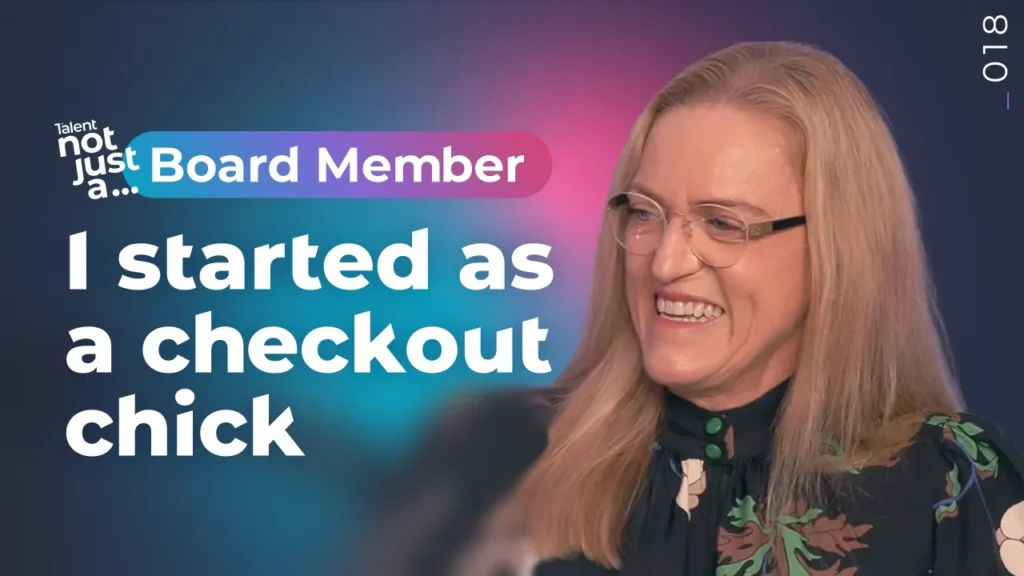
I started as a checkout chick and a waitress, and that really taught me the value of money and discipline and having to show up at work.
Then I was an occupational therapist for five years.
I actually wanted to be a doctor. That was my dream job in high school, but I didn’t quite get the grades. I went back to uni to do a bridging year in arts to get the grades. After I’d done it, while I could have got into medicine, it was a bit scary. I was like, gosh, that’s going to take a long time before I can actually earn money.
I was getting to that point in life where I needed to earn money. So I still wanted to be in the medical profession and I wanted to help people, so I decided that I would become an occupational therapist.
That also has really helped me in my business career, which I don’t think most people would realise. As a student of occupational therapy, you treat lots of different clients and patients.
That was the time of the AIDS epidemic, so I had the opportunity to work with AIDS patients, burns victims, geriatric psychiatry. I really learned about people and how to have compassion, which is really important in business, which we don’t think about.
Also, which was unusual in those days, I ran my own business when I graduated, which wasn’t normal. So I also learned about what it is to run a small business that’s dependent on you. If you don’t have bookings, you’re not earning.
Then I transitioned from occupational therapy. I did an MBA, and that’s largely because my last job as an OT, I had a wonderful, wonderful boss and mentor. The business was workers’ compensation insurance, and I led the rehabilitation team, so we would provide insurance and then I led a team that helped people get back to work.
But my boss let me get involved in the business side of things, and he was really encouraging. He was kind of like, “You’re good at this. Go back to school.”
So I went back to school, which was fun.
Amanda: What did you study then?
Libby: I did a Master in Business, and I studied everything like the opposite of what I did as an OT.
As an OT, it’s biology and people and all of those things. I went back to an MBA and focused on maths and investing and accounting and all those more hard, tangible subjects.
Then I went into management consulting, and that is like a baptism of fire. You get a phenomenal opportunity to get involved in business problems and opportunities. You work really hard, but that all happens in a very short space of time.
Then I decided that I would leave consulting, and there were two reasons for that.
In the last couple of years, I spent a lot of time overseas in the US and Asia, and that is not very healthy for a marriage. There was a time when I was living in San Francisco, working in Pittsburgh, and my husband was in Sydney, so I’d come home for 36 hours.
That really wasn’t going to be good for the health of my future relationship. I’m glad to say I’m still married to the same man.
The other reason was I wanted to move from being in an advisory role in business to actually having the responsibility to do something.
I was lucky enough to get recruited into American Express, and I stayed there for a decade. I really credit them. They had wonderful talent management programs, and I think they helped me really develop into a leader.
I had the opportunity to run three different businesses while I was there. Then when I left American Express, I ran businesses in financial services, superannuation, telecommunications, PayPal, SaaS and enterprise tech.
So I’ve done a lot of different things.
Now I’m in my third act, if we quote Jane Fonda. That’s really about me taking a step back, I want to still contribute to the business community and to building businesses, but I want to be the neighbour that people know, not the neighbour that’s never home.
I want to spend some time doing things that I’ve always wanted to do but never had the time to do. So I’m trying in this phase to make a difference, but also find some more balance.
Amanda: That makes sense. That is an incredible career, and so many different elements have contributed to your success — from the people skills and then the business side of things, and learning about the back end of a business.
For a lot of people, they get pushed into a big organisation and they don’t really get to see how balance sheets come about, or how a strategy comes about, or vision and mission and whatnot.
I think it’s awesome that your boss at the time gave you that opportunity.
If you were talking to a young person today coming into the business world, what would be your tip to help them succeed?
Libby: I think focus not so much on promotion and climbing the ladder, but getting as much breadth as you can and doing new and interesting things because it all contributes to your toolkit.
It opens doors to other opportunities that you might not have considered.
I never had a plan that said, when I’m 40 or 50 or whatever the age may be, I want to be X.
I only ever had a plan of, I feel like I’ve done whatever I came to do in this role, and now what else can I learn, develop, help?
So that would be my advice.
Amanda: You’re on two boards, I believe, at the moment. I think it’s kind of an elusive world, being a board member. How did you get onto a board, and how do you get onto a board?
Libby: There are lots of different routes.
Networking is a big part of it, and people knowing that you’re making the transition.
It actually took me a while for people to stop calling me, like recruitment companies, and asking me, was I interested in CEO roles, to actually getting people to start calling me and saying, would you be interested in this director role?
Obviously, I’m talking to a wide range of recruitment companies because you don’t know who’s going to get the mandate for a board that you might be suitable for.
Then it is networking more broadly in the business community to say, this is what I want to do. This is what I care about. This is where I think I could make a difference.
It’s mostly through those two channels, and it takes time. I’d actually say it’s harder than finding the next executive gig.
Amanda: I feel like it would be.
We’re obviously here to talk about you behind being a board member, so I wanted to know, who are you when nobody’s watching? Tell us about the version of yourself that exists completely outside of work.
Libby: I think this is a tricky one because I think it’s changed over the years, and I think it’s changed because of the roles I’ve been in. I think it’s changed because community expectations are different and what people need at work is different.
In all honesty, when I was an OT, I was the same person inside work as I was outside work. Female-dominated profession. When I did my training, there were 60 girls and two guys, and that kind of transcends then into the workforce of occupational therapists.
So you are who you are. I don’t know how to explain it any other way.
It wasn’t until I became a management consultant that I started to get all these messages — and remembering, we’re back in time — that I needed to be someone different at work.
I’ll give you a couple of examples.
I was sitting next to a senior partner on a flight, and one of the things I like to do, it’s my downtime, I read WHO. I still read WHO. I love the pictures and the gossip. It’s a cup of coffee, read my magazine.
So I’m sitting on this flight reading my WHO magazine, and literally this partner was kind of, “That’s really not appropriate reading material. You need to be in your downtime reading more thoughtful, business-oriented books.”
So I was like, oh, okay.
Another example would be, and I know I’ve got a skirt on today, but because we were working really long hours and we were travelling a lot, I honestly preferred to wear trousers, so I’d wear a trouser suit.
I got told, and again, I’m not sure it’s the same today, but I got told, “It would be more appropriate if you had a skirt.”
So I think being in management consulting started — I did divorce my work life from my personal life because I felt like at work I had to be professional, results-orientated, focused. So I tended to cultivate friends that weren’t part of the work environment. I could be silly. I could read my WHO magazine. I could joke around and have fun.
Then that carried into my business career really until I led PayPal, which you mentioned earlier.
That was a big, big change for me because I had a much younger workforce than I’d had in any of my other roles.
I had a phenomenal communications manager who I’m actually still friends with today. What she helped me realise was that for that generation, it wasn’t enough to have strategies and plans and economic models. They wanted to know who I was. They wanted to know why they should care. What was my purpose?
I’ll give you an example.
I remember being at this town hall, and I was making some announcements. One announcement, which I thought was really good, was we will pay for everyone’s City2Surf race membership, and we’ll put on a party at the end.
I thought that was pretty good. They would like that. That was okay.
Then I said, “We’re going to sign the petition to support gay marriage.”
So I’m sure you know what got the biggest cheer. That cost us nothing, other than we were putting our reputation as PayPal in Australia and New Zealand in support of gay marriage.
That was a big kind of, gee, it’s as important to be who we are at work as outside of work.
I think that subsequently has changed the way I lead. Since then, to be more vulnerable, not have all the answers.
Amanda: Was it hard for you to make that transition?
Libby: Oh, sure. It sounds easy now.
That’s why I say Kathy, who was my communications manager, had to help me understand. It wasn’t one chat and I get this. It was, “See how when you did this, this is how they reacted. And see how when you did this?”
Because I’d been trained to separate. A whole bunch of senior people had instilled in me not to be who I was. That’s hard to change behaviour.
Amanda: When you became head of PayPal, I’m assuming that was your chance then to say, yeah, I can read WHO magazine and I can wear my trousers and I’m not going to put any of those rules in place for my team members.
Was there anything else that you feel like you broke down?
Libby: I think they did it for me as much as I did it for them.
It was a two-way street. I think I learned as much from the team as they learned from me.
For example, another thing we did — because culture is really important in an organisation, and everybody knows you need to engage the people in the organisation and empower them to build the culture they want to be part of.
I went one step further. We had a culture team and I said, “Here’s a budget. No rules. You come back to the management team, so not just me, and tell us what you want to do with this budget.”
There were a few principles, right? They weren’t allowed to go down the pub and blow it all. So there were some principles about it being inclusive and various other things, but essentially they were in control.
Again, I think they helped me learn, and then I helped facilitate.
Amanda: This leads me to my next question. What’s something you’re deeply passionate about that would surprise people who only know you professionally?
Libby: I was also an aerobics instructor through the 80s.
Amanda: Wow.
Libby: I am actually deeply passionate about sport and fitness and activity, particularly as we age.
I think it’s really important for our mental as well as our physical health. Certainly for me, it’s been something that has carried me through a lot of stressful situations from a work perspective, to have that outlet to refocus, reprioritise.
Now things have changed. I do believe in if you don’t use it, you lose it, which I think for quality of life is really important that we keep doing things as we get older.
I used to believe in no pain, no gain. Push through, go hard or go home. A couple of back injuries, knees that are a bit worn out, and I’ve learned that moderation is key. We want to keep going.
I really am very passionate about health and fitness. It’s good for your brain. It’s good for your spirit.
This year, I’ve actually been joining a group of ladies, mostly older than me and also mostly much better than me, at tap.
I’m useless, right? But I go and I try. The ladies are very encouraging. I walk out feeling it didn’t really matter that I made a mess of it. My brain was working, I was having fun, and I feel good.
So probably people wouldn’t know that about me.
Amanda: That’s so cool. I love that you have all these different hobbies.
Libby: Well, I have time now. I’m doing a lot more now than I did in the past.
Amanda: Back in the day, did you have hobbies?
Libby: Back in the day, I would prioritise health and fitness, but it was scheduled and it was individual. It was fitting into the work schedule and the work priorities. Whereas now it’s much more exploratory.
Amanda: When you started at PayPal and became a leader there, was that something that you really encouraged in your team members, to prioritise health and fitness?
Libby: Always. In my whole career, it’s always been something that I have prioritised.
Amanda: What song are you dancing to at tap currently?
Libby: It’s mostly like “All That Jazz” and things like that. Very musical stuff.
Amanda: Do you like musicals?
Libby: Yeah, I do.
Amanda: What’s been your favourite one that you’ve seen recently?
Libby: Lately, I saw MJ the Musical, and I was a bit worried how they were going to tell the story. It was a bit controversial, but I loved it.
Amanda: It’s so good, isn’t it? We had Shewit, who is one of the actresses from MJ the Musical, on the show a couple of weeks ago, but yeah, she was so great.
Now that we know more about who you really are, what’s a lesson you’ve learned outside of work that actually made you better at your job?
Libby: I think yoga actually made me better.
Amanda: Another hobby. I love this.
Libby: So you are learning more about my stuff outside of work.
Do you know what shavasana is?
Amanda: No.
Libby: Shavasana is that bit in a yoga class where you lie on the floor at the end, and you’re supposed to clear the mind and integrate the practice from today and be very present.
That’s what shavasana is.
I would go to yoga and I hated shavasana, so I didn’t do what I’m supposed to do. I would lie there, resent that I had to lie there, but I would make a long list of things that I had to do as soon as I could get off the floor.
But I had a wonderful teacher called Carolyn Coggins, and I also had a back injury at the time, so I had to go slow. So I started to do it properly.
I was really surprised because I would get up and actually, I would feel much better from the class than I had when I was lying there going, okay, I’ve got to organise this meeting, I’ve got to schedule this.
Amanda: How did you do it?
Libby: I forced myself to do it, and then I started to see the benefits.
Then I also saw I’d go to work, and because my brain wasn’t rushing, I could hear people better. I was listening better.
What happened was I was always someone that would go too fast. So often if you were talking to me, I would be already thinking how to fix your problem, because I like fixing problems, as opposed to listening to what you were saying and hearing what you needed, which might not be what I had decided was how I was going to fix your problem.
So I started getting better results and achieving more.
But again, these things are easy to say and hard to do. It was many months.
Amanda: It feels like it would take quite a bit to train your mind to change something that you’ve been doing for so long.
Libby: Yeah, it’s like meditation. I do a little bit of that now, but when you first start, it’s kind of like, I don’t think I’m doing this. This is a waste of time.
But it is just by sitting there, slowly, slowly, slowly, you go, oh, yeah.
But that doesn’t happen with one meditation session.
Amanda: Nothing’s overnight, I guess. You’ve got to work at it.
What would people be most surprised to learn about what your job really involves day to day as a board member?
Libby: As a board member? We get to talk about work. Okay.
I think what people would be most surprised about is that how you go about being a board member is very different in every situation. It’s different in every company that you go on the board of.
In each situation, your roles and responsibilities are governed by regulation and by the charter and various other things. There are quite clear rules and fiduciary responsibilities about being a board director.
You are clearly responsible to act in the best interests of the company, and you need at the same time to meet all of the stakeholders’ needs — shareholders, customers, employees, the community. That’s all very clear.
Most people would know there are board meetings, there are committee meetings, and you have to read copious documents before you go to those meetings.
But it’s actually about all the other stuff that you do and the judgment that you apply to how you’re going to make a difference.
When you first join a board, that induction is super, super important because that is your opportunity to say, “I’m new.”
As a board member, formally, it’s not a lot of touchpoints. It might be 10 to 15 meetings a year. But when you join, you have an opportunity to say, “I really want to make sure I understand the business. I get to know the people. I talk to the stakeholders. I understand the expectations of shareholders.”
So I think what people don’t realise is — and that’s why you don’t want to join too many boards all at once, you want to stagger it — because you want to spend a lot of time and make an investment in that induction process.
That’s number one.
Number two is then you’ve got to stay current, and the formal stuff is not enough.
Again, each company will be different. But I do things like engage with the product or service so that I know how it really works. If I ring up the phone or walk in the store. I’ll do site visits, which is something occupational therapy taught me as well.
I’ll even go to a Friday drinks function or some events so that you can just chat to people at all levels in the company and get a feel for it.
I see an engagement report in the board meeting, but what does it feel like when I hang out in the kitchen?
I will go to board meetings early, always, and I will often sit in the kitchen and have a cup of coffee. If people are prepared to chat to me, I will have a chat because that gives me a feel.
So it’s all of those things that I think people don’t see. There is a lot of judgment.
There’s no rule book that says this is what you do. It depends where the company is at, what they’re trying to achieve, as to how you apply yourself.
Amanda: How did you choose which companies you wanted to be a board member for? Was there something you were leaning towards? Did they need to have great culture, great products, great customers? What made you drawn to the companies that you’re a board member for?
Libby: They had to be companies where I felt that I had something to offer and that I could add value.
One of the boards that I’m on is a digital infrastructure company. A board is a group of people, and you want to make sure that that group of people collectively has a breadth of capability. You’re working together. It’s not one job, one individual. A board is a collective responsibility.
One of the things that I bring to that board, which is different to some of the other board members, is a depth and a contemporary depth around technology. The company is essentially a technology company, and we have been going through some significant change. So I have value from that perspective.
The other company that I’m on the board of is professional services, financial planning and accounting business, and it’s a company going through huge growth.
It’s a combination of — I led the superannuation business at AMP, I ran ipac, which was a financial planning business, and I also ran a tech business that delivered SaaS and enterprise software to financial planning, wealth, etc. So I understand the space.
But also, a lot of the roles that I’ve had in the past, we did a lot of integration, transformation and growth-oriented work. So I bring that skill set.
Others on the board have much deeper financial capability than I do.
That’s the number one, being really clear.
In order to add value, you have to have an interest. Coming back to your question about what would surprise people, it’s not enough just to engage with the company. You have to have a bigger lens on it and say, what’s happening in the industry? What’s happening in the future?
A big piece of value that you add as a board member — and I remember when I was a CEO, you’re pretty busy and you’re focused on near-term stuff. What’s happening in the next 12 months? That’s most of your focus. You try and helicopter up, but it’s hard.
Whereas you want board members that are supporting and challenging you, that have the time and the space. It is important not to be too busy because things can go wrong, and when things go wrong, you as a director have to help.
But also, if you have time, you can sit back and reflect and think, right, we should think about this for the future. Where is the technology going? Where’s the industry going?
So you have to be interested. I think you have to have a value proposition and you have to be interested.
Amanda: Do you think there is an age limit on when you can become a board member?
Libby: This is a tricky one, and some people would disagree.
I think the more experience and the more breadth that you bring, the more value you have the opportunity to add.
There is an argument for having younger generations on a board to bring that perspective. Again, it’s horses for courses. It depends what the company needs. That’s why what boards do is say, what do we need right now? What is the skill matrix? Who have we got on the board? Where do they fit? Do we have any gaps?
There are times when perhaps you need somebody with more specificity.
But remember that while you work collectively as a director, from a fiduciary perspective, you are individually responsible.
You don’t want to be on a board and not have the business experience to sign off on the numbers. You cannot say, Fred is, you know, I’m going to sign off on that because Fred says it’s okay. That is not okay.
So you need breadth of experience, I think.
Your question was age, and I don’t want to be ageist, but my personal bias is the longer you stay in operational roles, the more value you have the ability to contribute.
Amanda: Very interesting.
If you’re from a comms background, for example, and you want to get more involved with the numbers, what would be your number one tip to really understand a profit and loss statement? I’m not great with the numbers, but I would love to know more about all of that stuff.
Libby: Look, I think — you did maths at school?
Amanda: I did it probably very poorly.
Libby: I think number one, it’s really not that hard.
I think if you have an interest — so you have to have that first, and it’s okay to not have an interest. It’s okay to be a marketing or a PR professional and say, “I don’t want to do that.” Everybody’s different.
But if you have an interest, engage in it. First of all, just talk to your internal team. I think you’d find an accountant in the team that would love to sit down and take you through it and help you understand.
Then seriously, do a course. There are lots of courses. There are free ones online. You can do something more sophisticated.
For me, when I went through that transition, it was mostly the team. I would put my hand up and say, “This is the amount of costs that I think we need to invest in the rehabilitation team to complement the insurance book that we have.” Then they helped me understand, okay, how do you build a business case?
When I went back to my MBA, I had never seen a spreadsheet. So I had to learn how to use it. My first NPV, net present value calculations — financial term — I did longhand on paper.
If you have an interest, you ask people. The wonderful thing is, if you have an interest, most people want to share.
Amanda: So true. This leads me to my last question. You’ve shared many talents, Libby, but what is your hidden talent?
Libby: Hidden talent. That’s also a tough one.
I think I’m hardworking. I think I’m resilient. And I think I have a reasonable amount of courage.
If I look back on my career, I’ve often taken the jobs that maybe other people didn’t really want, that everybody thought would be too hard.
Some people would say I’m persistent, tenacious, intense. I like to say courageous, resilient and hardworking.
I think that comes from when I was a kid growing up. I would say we were definitely lower socioeconomic. I couldn’t remember a time when budgeting the family meals wasn’t straightforward. It was a thoughtful exercise.
I haven’t realised it until retrospectively, but I’ve realised that why I like building businesses so much and why, even though I’m sort of semi-retired, as I say, I still love being involved with my boards and helping.
Because the more sustainable that we build businesses, the more people have incomes and can enjoy all that other fabulous stuff that is outside of work.
I think growing up built that kind of resilience and hardworking. We figure this out. We’ve just got to work at it.
Amanda: So true.
Thank you so much for joining us. It was fabulous chatting with you. You’ve had an incredible career, and I loved learning more about you and also how you became a board member and how maybe one day I might be a board member.
Libby: Absolutely. Lovely to spend time.
Amanda: Thanks, Libby.
Libby: Thank you.
Enjoyed this episode?
Explore more conversations with inspiring leaders and innovators on our podcast or subscribe to our YouTube channel for the latest episodes.
We know that talented people know talented people. If you’d like to talk to us about how we can support your business, get in touch.