
Episode 16 – Not Just a Chef with Adam Moore
Episode 16 – Not Just a Chef with Adam Moore
Episode transcript
Note: This transcript has been edited for clarity and readability while staying true to the spirit of the conversation.
Amanda: This is Not Just A…, a podcast where we get to know the person behind the job title. I’m your host Amanda and today we’ll be speaking to chef Adam Moore. We chat about his charity work, the legacy he wants to leave, and his love for writing. Above all, we talk about who he is behind the job title. Let’s get into it.
Amanda: Adam, welcome to the podcast.
Adam: Thanks so much.
Amanda: Thank you so much for joining me on the couch. I’m so excited to have you. I’ve been reading all about you, I’ve seen your things on Channel 10, and you’ve got an Order of Australia medal. I feel like I’m not going to do your bio justice, so can you please give the audience a quick overview of all of your achievements?
Adam: Wow. I’m Adam Moore. I’m a chef. But you talked about my Order of Australia — I do a lot of charity work. I’m a national ambassador for Cure Cancer, national ambassador for R U OK?, and I’ve been doing charity since I was 13 years old.
But I’m not just a chef. I’ve got a pastry chef degree, I’m a butcher by trade, a charcuterist, a food scientist. So, someone that really loves the industry. I’ve been a chef for 33 years and enjoy every minute of it.
I forget what I do. I think I undo my justice as well because I forget what I do.
Amanda: I think you’ve done so much. Charity from 13 — what was that charity?
Adam: Charity when I was 13 is probably what’s driven me today. I still do it as much as what I probably did when I was 13.
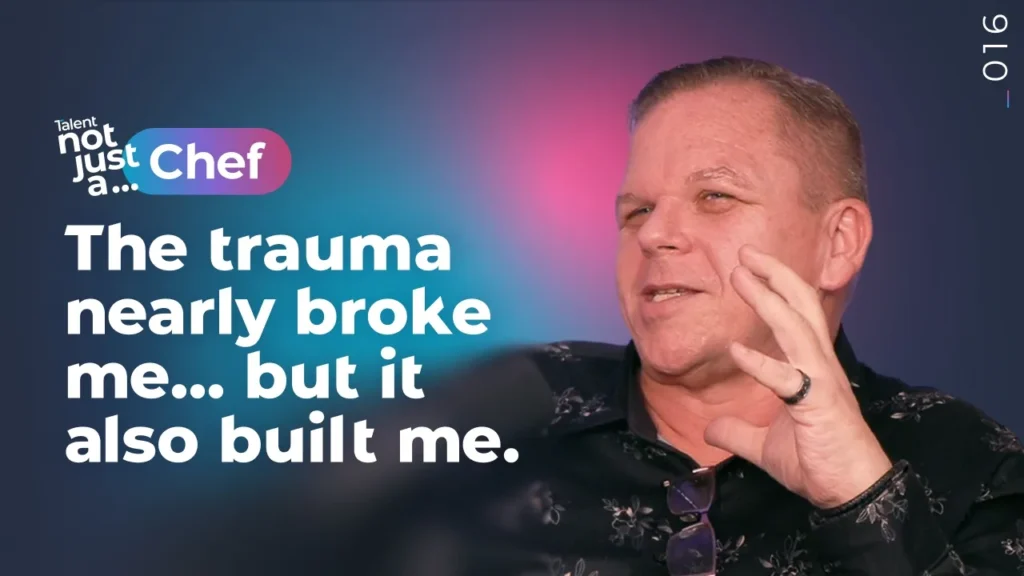
From trauma, good things come. I started doing charity work to forget about trauma or run away from trauma. I’m not afraid to talk about it now.
I just started as a young kid doing things like cake stalls, and at the time it was small. One of the things I did do was start a soup kitchen when I was 13.
I was working as a 13-year-old back then, when you could do that, and every bit of money I had would go towards the soup kitchen, buying food. Then I realised, hey, there’s this whole food world that could sponsor. So I started doing it.
We’d get bake sales of $50,000 in a weekend, where I would rent out bakeries and use them on the weekend because back then it was different. I could do that.
By the time I was 17, I had raised over $2 million for charity, doing soup kitchens, raising money for all sorts of charities and funding my soup kitchen.
By the time I was 18, I was honoured with the great honours that I have today, which most people wait 60 or 70 years for and go, “I’ve got the Order of Australia.” So, community service.
Amanda: So impressive. Raised $2 million by the age of 17, having started at 13. That is unheard of in so many circumstances.
Adam: Raised a lot more since then. It’s been so amazing. I didn’t have any goals for it.
I had a school principal. She was a nun because I went to a Catholic school. I had just had this trauma and was going through some counselling. She came into our class as a substitute teacher because one of the teachers didn’t show up, and she said, “What do you want to be in five years? In 10 years?”
It pretty much started where I am today. She said, “Write down some goals that you want to achieve.”
I wrote down, I think, 238 different goals. I didn’t do it in one day. I did it over a couple of days on the weekend. I showed her and said, “There’s a whole list of goals.”
I always knew at that age I was either going to go into food, be a teacher, or work in theatre — live theatre, that sort of thing — because I was really passionate about all those. It’s funny that all three of those jobs I’m doing today.
Amanda: I was going to say, I feel like you’re doing all three of those jobs. You’ve achieved and manifested what you wanted to do.
Adam: Sister Pat looked at these goals and said, “What do you want to do? How are we going to start making it?”
That’s when I started charity because she was involved with lots of charities, being a nun. So I started joining with her, and that’s how it started. Then I started crossing off goals.
Some of my goals were ridiculous ones, like being Prime Minister of Australia. That’s not going to happen. I’ve crossed that goal off because I’ve actually gone and tried it.
My main goal was to be a chef. Teaching just comes naturally, so I do that with my mentoring today. And the sound and lighting, working in TV, working in that arena — I’ve kind of ticked those boxes.
Amanda: It’s so impressive. Can we talk about the trauma? What happened?
Adam: When you’re involved in certain associations, and I don’t want to name them because those associations are great, unfortunately there are some people in those times. Sexual assault is a common topic now.
It was hard for me to talk about it a long time ago. Because of that, I also put on a lot of weight. I have lost weight. I’ve had gastric sleeve surgery and I lost over half my body weight — 96 kilos.
I had internal struggles about that. From trauma, you do run from it. You do hide it. A lot of people go for an addiction, whether it be drugs or alcohol. Mine was eating.
Whatever happened, it happened. I’ve now dealt with that. I’ve had too many counselling sessions because of the blame. You blame yourself, you blame everyone else, you blame society.
Even me talking about this now, there are a lot of people, even family, that probably haven’t heard me be so frank about it. But I’ve had to face it for me to lose weight as well, because it was something that was holding me back.
Only a few family members know about it. My own father, I haven’t even told. So he’ll probably hear this, and I’m not afraid of having that conversation now.
I am the person I am today because of it, but I’m still the same person. I’ve still got the same determination. I always had that. It just hindered and probably changed course for me.
Look, positive and negative. It was probably something that happened. I probably wouldn’t be who I am today. I wouldn’t be as busy.
I think I tried to be so busy with charity and doing everything at school, from being on student council, debating team, being on sound and lighting — I did everything.
It’s funny. A lot of people at school would say, “Adam was always that guy.” And I did it because I didn’t want the noise.
It’s probably driven me very hard in my career, but also trying to have that success so that my past didn’t catch up with me.
Amanda: It feels like it hasn’t defined you. You haven’t let it define you. You’ve wanted to move past it and do great things with your life.
Adam: Everyone has something in their life that’s not perfect. Whether we air that or we don’t air our dirty laundry, I think people need to talk about that.
It’s interesting. I can relate that to all the young people that I mentor. I don’t mentor just chefs now. I mentor people from all sorts of walks of life and people that have had trauma themselves and try to hide the trauma through, unfortunately, things like suicide.
What I find when I’m mentoring people is going to the problem itself in a safe environment changes the conversation.
I think that applies for every industry. Everyone has a moment or a weakness that we think is a weakness but actually is a strength.
I’m not a doctor. I’m just someone that has lived life. In the same thing, I’ve actually also loved life. I appreciate what I’m doing now.
Charity work — when I’m doing charity, I did a great event with the Bobbin Head Boat Club on Sunday, which I’ve been doing for six years. It’s a group of members coming together, raising money for Cure Cancer. I’ve changed my flight schedules and everything over the last six years to be there.
I’m so positive after it. You just feel so enlightened because you’re giving back.
I never thought in a million years as a chef — even though I do food science and all that — and I failed maths at school and failed religion.
Amanda: So did I, by the way.
Adam: I failed maths and I probably do more maths equations now.
The charity part is something that I keep giving back to and it keeps driving me more. It’s not just one charity, it’s multiple.
I’m working with Cure Cancer. I’m working with researchers and professors and doctors. I’m a chef, but it’s amazing that you can have those conversations with a professor or a doctor that’s doing this amazing lifesaving research.
I’m a chef, I’m not saving lives, but these people are. What I’ve been able to do is relate to them with my story of food, because I think food is the universal language. That’s the best thing I could ever learn travelling the world.
No matter where you are, you don’t have to speak a word of the native tongue in any country you travel, but you share food and you’ve got a common bond.
I think the same thing with charity, my mentoring, everything that I do — it’s related to food. That’s the best way I can put it.
Amanda: This whole podcast is about how you’re not just your job title, and I think you’re the epitome of that. You’re not just a chef. You’re doing so many amazing things and so many people probably know you purely as a chef. It’s great that we are talking about all of this.
Adam: There’s my charity work I don’t normally talk about, and my mentoring I keep very private. Only my closest friends really know what I do.
First of all, the world doesn’t need to know everything. Although Cure Cancer I have been promoting on my social media, and R U OK?, because it’s an important message to get out. That awareness is what we need to do.
Cancer is one of the biggest killers in this country, doesn’t matter what form it is. There’s someone that’s affected in your life, your friends, your family — everyone knows somebody.
Talking about it and talking about what these wonderful researchers are doing, groundbreaking, world-leading research — and here I am as a chef and I can share my story as food.
I also find, not just with charity, I love music. I can’t play music at all, but I love music. Even sharing stories of how bands got inspired by the food that Mum used to make on the sidelines or in the back docks and things like that.
Everyone has these moments of food, whether you’re a good cook or not. There are these moments that you share. It might be a mother and a child. You have that bond. A child and a grandparent. Even just cooking with friends socially.
You’re cooking with love. You’re sharing laughter. You’re sharing stories.
Some of the best moments of my life are when I’ve been in restaurants and guests come in, and you don’t realise you’re making a moment in their life. They’re probably celebrating an anniversary, a milestone, doing their engagement or proposing — whatever it is, there’s a moment that you’re sharing.
I learned this when I was in the restaurant game. Every time I’m doing something for a guest, you don’t know how much of a difference it can make to those individuals.
I still have guests coming up to me, and their kids are now grown up, they’re adults now, and they’re going, “Oh my God, you used to cook the steak and this is what you used to do.”
It’s phenomenal to have that story. It doesn’t matter if it’s people in restaurants, guests, celebrities that I’ve cooked for — the same story is being shared.
It’s probably the most important part of my life today, having that message. I’m probably the biggest food nut in the world.
People that meet me, they’ll know about food. I’m going to talk about food history, food brands, whatever it is.
But I also talk about having those moments where I’m mentoring a young person that’s struggling in life and having a moment with them. It makes a big difference. Sometimes you may not ever see those people again, but they’re always a part of you.
If I left this earth tomorrow, I could look back and say, you know what, I’ve achieved — and it’s the first time I’ve actually looked at it this way — I’ve achieved. Even though I’ve achieved so many accolades in my life.
Sorry, I’m getting a bit emotional. I actually haven’t taken the gravitas of what I do. I just keep going.
People say, “Are you happy?” And I’m like, yes, I’m happy with what I’ve done. But now I’m in the stage of my life where I’ve laid the brickwork down and the legacy has been built now.
The most important thing about that is my daughter is my most important legacy. The hard lessons I’ve learned, I didn’t want her to see a lot of that.
She’s also seeing the world in a very different place. She’s growing up now, and you know how old you are when you have kids because they get older too. She’s making decisions in her life now that I was making back in the time, but the decisions she’s making are very different and not clouded by anything that I went through.
That legacy has been built now, and that’s probably the most important thing. No matter what you do in life, do something with purpose. Do something that means something to you. Doesn’t matter what anyone else thinks.
All my hobbies that people don’t know about — I do so many things. I’m not just a chef jacket. Unfortunately or fortunately, there are people in the world that still think my name is Chef because I’ve worked for big corporate companies and because I was the chef, they’ve called me Chef all my life. It doesn’t help that my number plate is Virtual Chef.
But I’m not defined by that. At one stage, people used to think I wore the chef jacket all the time and slept in it. Then when people see me in casual gear, they’re like, “Who are you?”
I’m not defined by that. It’s what drives me today. It’s my passion, it’s my love, it’s everything I do, but I’m not defined by the job role.
I had a friend tell me the other week — and I’m one that will work long hours, I’m not afraid of long hours — but someone said to me, “You don’t get beloved work member or beloved worker or employee on your tombstone. It’s beloved family member and friend.”
As I’m getting older, I’m starting to realise that’s the importance now. No matter what I do, I’m doing it for myself. I’m doing it for my family. I’m proud of what I do.
It doesn’t matter what career you are, that’s the most important thing. Do the things you love. Do your hobbies. Don’t wait for tomorrow because tomorrow may not come. Let’s do it now.
Don’t have a bucket list. Do the things now. Do the things that give you joy. Do the things that give you fear. Do the things that give you excitement.
I’m still learning in this game today. It doesn’t matter what career I end up in, I love what I do and I love talking about it.
Amanda: It’s so inspiring. You would make an amazing mentor. I feel like I want you as my mentor.
Adam: Mentors are someone — and I’ve been very privileged in my career to have many mentors, some good, some bad. Mentors are there to teach you a lesson, whether it’s a short lesson or a long lesson, whether it’s a hard lesson or whether it’s an easy lesson.
It’s someone that has gone through that lesson and used their own learnings of life to create that advice. It’s not a doctorate. It’s not a piece of paper. It’s hard-earned living.
It’s something that, if you were to really look at and evaluate, it’s a skill set that we often forget.
I say this to everyone: everyone has a story in their life. Doesn’t matter who you are. We all have a story and we all have lessons that we’ve learned. You never know if your lesson is going to be of value to someone else.
It doesn’t matter who you are, where you are, what job title you have. You walk into a building, it doesn’t matter if it’s the janitor, the receptionist, the CEO of a corporation — you treat everyone the same, how you want to be treated.
In that space, you’re doing your best by doing that. You can’t control what someone’s thinking. If you’ve got a judgement on me, that’s not my problem. That’s your belief.
Let’s just treat everyone normally. Be excited about life. Do the things that you want to do, but don’t let things be a burden.
I’ve had that trauma. I ran from it. Yes, I did hide from it. Yes, I did gain the weight. But at the same time, I’ve also done some amazing things.
As I’m getting slower in life, I go, right, I don’t need to do as much or do bigger, better things. I can actually do things and just be happy with that.
I grew up in an era where social media didn’t exist. Now I love social media. People are always trying to do something. What I say is just tell your story. Talk about it. Ask questions. Don’t be afraid of making mistakes.
I’ve made mistakes, but you learn from them. That’s my whole life. I’m not perfect. I know that. I always strive for perfection, but as you get older, you realise success and perfection are different.
Amanda: I feel like you would be the type of person who brings your authentic self to everything you do. I don’t think I could say that you would hide anything when you’re at work.
Adam: When you see me, I love people. I’m out there. I will engage. I get more energy off people. I’ll socialise with anyone at any party, any function, and I’m okay with it.
But also, I like to be at home, quiet in my space. I’m a creative. I like doing things. I have lots of ideas, but I also love listening to music and vinyl, being with my family, being with my friends and just enjoying life.
I’m not always on. When you see me, you are seeing the same person, just different levels of volume.
Amanda: Now, what’s your favourite band? Who are you loving at the moment?
Adam: I have an eclectic world of music. I love all styles. Musicals is one thing I really love. Meat Loaf was one of my biggest albums in the world, and I’ve met Meat Loaf. I’ve been on Rove Live with Meat Loaf. I’ve been on TV with Meat Loaf.
Unfortunately, he’s no longer here, but Meat Loaf was something I listened to when I was 13, so probably there’s a strong connection there. It was kind of like the anthem for my life.
Then I go into 90s indie pop. I love The Killers, I love The Cranberries, all those fun things.
Amanda: Are you a Swiftie?
Adam: Look, I wouldn’t say I’m a Swiftie, but I do appreciate some things.
Amanda: I am ex-music industry, so I did 10 years at Sony. Music is a big part of my life as well.
Adam: Fantastic. I never thought music — I’ve been able to cook for bands. I’ve cooked for some major celebrities in the music industry, and again, I’m sharing that food story.
It doesn’t matter what industry. I can walk into a room and start saying, “What’s your favourite food?” It doesn’t matter. It could be a famous band member.
I’ve been lucky to cook for Neil Diamond, Jimmy Barnes, The Angels — all these amazing people.
Amanda: Has anybody surprised you that you’ve met or cooked for?
Adam: I look back at my life and I’ve probably had the luckiest career as a chef.
As a young chef, I had opportunities to work with a lot of people — presidents, King Charles when he was Prince Charles. I’ve had so many opportunities and so many celebrities, unfortunately now passed on as well.
For some reason, I keep going in that space.
When I was growing up, one of my absolute heroes was Bert Newton, and I got to cook with Bert Newton. Bert Newton was also the same guy that gave me advice about getting into TV.
It’s interesting that I’ve been able to do that. He was very simple. I still can remember his orders in my head very clearly.
I think some of the biggest stars have been the most humble. I’ve worked with stars as well, and it doesn’t matter what type of fame it is, whether it be music or celebrity.
There are people that you just go, let’s not talk about that. And there are amazing people in this world that just keep being their natural self.
There are people that put a face on too, and they’re the people that give you the biggest surprise. They always say never meet your heroes. Sometimes you don’t want to.
Amanda: I agree. Do you have a dish that was a very early memory in your life that made you want to be a chef?
Adam: I have two. Two for very different reasons.
One almost broke me and didn’t make me be a chef, and the other one has defined me.
The first one, and it haunts me still today, is apricot chicken. A 90s dish. Very controversial dish.
I remember at school cooking apricot chicken, and I was so excited by this. I grew up in the western suburbs of Penrith and my family were a hard-working, middle-class family. Apricot chicken was very foreign.
So I was so excited. I got all the ingredients and I cooked it for my family. I still remember that my mum, my dad, my brother and my sister — no one wanted apricot chicken.
Amanda: Oh no.
Adam: It was too foreign. I laugh about that now because they ordered pizza or whatever they ordered that night.
But many times in my career when I worked as the corporate chef and was doing consumer research, one of the power recipes was apricot chicken. It was coming in, and I’m like, “It’s really haunting me.”
I’m haunted by the apricot chicken. It almost broke me. I almost didn’t become a chef because of it, but it’s come back in my life in different ways. Every time I hear apricot chicken, I smile and go, yep, I remember that.
The second one is I love pork. Crackling roast pork. My very first TV appearance was with Ita Buttrose, who is just scary to meet for the first time. She’s such a lovely person, but her reputation was huge.
I had to do pork crackling on national TV, which, if anyone wants to know any secrets, doing cooking on TV is probably the hardest thing you could ever do because everything’s fake. Even the bench that you have and the scenery behind you, everything’s fake. You have to do two days’ worth of prep and you do multiple dishes, so it’s not easy.
Doing pork with perfect crackling is hard to do.
I nailed it on set on my very first TV performance with Ita Buttrose, one of the harshest judges. So it’s still something very endearing to me.
I still love it. Those that know me, I love my pork. But I love all ingredients, and Australian Indigenous ingredients is something I love playing with. Food, I never stop with.
Amanda: Before the camera started rolling, we had a catch-up and we were chatting politics. What’s something that you’re really passionate about that people don’t know? And you don’t have to say politics.
Adam: I’m interested in people. Understanding the study of people. Everything from what people eat, their behaviours, all that.
I’ve even studied with Allan Pease to understand body language. I love people. That’s one thing. Most people probably get that from me.
If you’re in a room with me, I’m already analysing what people are doing and trying to understand what’s happening in the room and reading the room. That’s like a superpower to me.
Amanda: Can you read me? Can you give me a reading? I would like a reading.
Adam: You can tell by people’s body language when they walk into a room. How they carry themselves. If they’ve got pride in themselves.
There’s a lot you can tell. We give a lot away from facial expressions, our body, and secret body language. People don’t realise that we do these simple things if we’re nervous with someone.
There are so many great books and Allan Pease is a great Australian author about body language, so definitely have a look at that. That’s the secret thing I love. A lot of people don’t realise I actually do that.
I love it. I’m a massive collector of books and I’ve got cookbooks. I read them like novels, whether they’re good or bad. I love the food history ones. I’ve got signed Auguste Escoffier, who is like the grandfather of cooking for me, so I’ve got some beautiful books in my collection.
I still keep buying more. I don’t have any room for them. But cookbooks are something I love. People are like, “Oh my God.”
Then I’ve got other collections, like Lego and all that fun stuff. I’m not a hoarder. I’m a collector.
Books are something I love. Because I’ve talked about that legacy, writing has been so relaxing, and I get a lot of my creative control out in writing.
I even bought a typewriter. For those who don’t know what that is, that’s an old-school computer.
Amanda: We need to clarify for the younger generations.
Adam: Why did I do it? It’s an old art form. It’s very hard. You can’t backspace, you can’t erase it. So it’s writing.
I’m writing everything at the moment. When I get spare time, I just write. I’m writing everything. I’ve got books that are in the works.
I have my first book out, which was about bariatric surgery, which I went through. A cookbook, Not Another Bariatric Cookbook. That really drove me. I’m like, right, I want to write books.
Each time I keep getting more ideas. I’ve got one for Cure Cancer, a charity one, and I’m just working with some illustrators to potentially get that off the ground.
I wrote the cookbook I actually wanted to launch, so that’s ready to go. I’ve got a great name, and that’s already with an editor at the moment.
I also wrote a food history book about the study of food history because I love rediscovering that and understanding that. I’m such a history nerd when it comes to it. So I’m writing all my passions.
I wrote a food poetry book, which I love. I’m so excited by food poetry. A lot of poets around the world have written poetry about food, but there’s no real exclusive book just on food poetry.
So I’ve used my whole knowledge as a chef, as a passionate supporter of suppliers, farmers and producers, and I’ve written — it was just by accident. I was like, what if I wrote about asparagus? And I’ve written a poem exactly on that.
I’ve done whole ingredients, and this is a book that was purely fun. Lots of notes on catching public transport, writing down things, and that one’s ready to go. That one’s stunning.
I’ve even, funnily enough, been drawing. I’m a terrible drawer. Absolutely terrible.
Amanda: I love that you’re just going out there and doing it.
Adam: I’m doing it. I’m writing it. And this is not the only thing I’m writing. I’ve also written a self-help book about narcissistic abuse, which is interesting. I’ve had lots of encounters with that.
I never thought I would write a self-help book.
By the way, everyone has a story. Everyone has a book to write. It doesn’t matter what it is. Just write it. Sometimes they change. They evolve with the person.
I’ve even been writing TV scripts. I have no knowledge of that, but I’ve been writing things that excite me. I’ve got lots of TV pilots that I haven’t filmed, but I want to film.
Funnily enough, I’m starting to write a musical.
Amanda: Oh my God, I love this. Do you think that if you weren’t a chef, you would be a writer? But I feel like you also are now.
Adam: I like the creative space. The writing is just a secret passion that has really become that legacy foundation for me.
Being a collector of books, you appreciate it. I want my daughter to see that. I’ve got my first book, but I want my daughter to see that her dad meant something. For all my family and friends, the books for me are… and that’s probably why people say, “Why have you been quiet for a while?” I’m not quiet.
If any TV producer or anyone wants something, I’ve got different ideas. I even did a TV soapie, like a Home and Away or Neighbours sort of -esque, but everything I’ve done is food related.
Amanda: The musical that you’re writing?
Adam: Chef the Musical. It’s not called Chef the Musical. It’s got another name.
It’s funny, I can see it like TV. I can see it clearly in my mind. I’ve had to get these ideas out, and I’ve had these ideas for a long, long time. I just get them out and they’ve evolved.
Every TV show that I’ve written is about food. There are things that aren’t on TV at the moment. Things that people would be interested in.
Even the charity books I wrote were for Cure Cancer. I was telling the Cure Cancer team on Sunday, I’ve got this series of three books to talk about cancer for kids and families. All three books are related to stories that I’ve had with Cure Cancer and with the researchers, and all the names of the books relate to that.
I never thought I would write kids’ books, but it’s relating to my charity, it’s relating to food and my love of food. That’s it. That’s the secret right there.
Amanda: Your ideas, are they like lightning strikes?
Adam: All the time. Some days, nothing.
Every day on LinkedIn, I’m posting regularly and I’m writing. It’s interesting. My audience now is not just chefs. It’s people outside that world, and leaders.
I speak publicly to different audiences. I’ve done a lot of speaking, which I really love, and LinkedIn’s that platform — which, by the way, guys, if you’re doing social media, LinkedIn is something you definitely don’t treat like your resume. Treat it like a way of connecting with people, but also connecting with people that are in fields of your interests.
Every second day, I do a different post. I’ve just started a whole lot of articles that I’m going to do. I just went, you know what? I’m going to do it. I don’t need a big publication or anything like that.
I already write for publications now, but what I’m doing is going to be articles that are for LinkedIn. Things that I’m interested in. If people want to click into something, they click into it.
I’m writing. The demographic I’m getting is people who are engaged. I’m writing inspirational things every day or every second day, and things — very deep thoughts that come into my head — but I relate it back to things.
So Dead Poets Society, one of my favourite movies, I’ve often used them and the movie taglines as my inspiration. Music, songs. Mama Cass from The Mamas & the Papas did a song called “You’ve Got to Make Your Own Kind of Music”, and I used that as a post.
Things that interest me, I write as a post. If something happened to me that day at work, I use that post. The audience that I’m getting is engaged, so my writing has a meaning.
Going back to that, everyone has a story. Everyone should write a book. This is my secret passion. I’m probably letting it out of the closet now that I’m just loving what I’m doing.
Amanda: This is what the podcast is about. You’re not just a chef. There’s more to it.
Adam: I haven’t stopped yet. That’s the worst thing. I haven’t stopped.
There are things I’ve got to achieve and get my publications on TV.
It may not go anywhere, but at least I’ve attempted it. It can sit on a shelf.
Those artworks that people do, or that song that you wrote, or that poem that you wrote — don’t shelve it. Get it out there proudly, put it up, frame it and show people, “This is who I am.”
You come to my house, you’ll see the many cookbooks. You’ll see a lot of food memorabilia. You’ll see all my Lego collection, which is always fun.
Be proud of who you are. It’s like when you’re wearing clothing, wear what you want to wear. Don’t care about anyone else. If it looks good for you and you feel happy, wear it.
If I wear loud shirts, I wear loud shirts. I wear really nice different coloured jackets. They’re not traditional, but I’m okay with it.
Amanda: I think social media has changed that for a lot of people, where they’re influenced.
Adam: Be yourself. I think that’s what social media is now teaching people. A lot of people are not over-editing.
If I make mistakes on a video, I just leave it on there because it’s who I am. I’m not going to edit my life. I’m not a glamorous mirror. I’m who you see, and I’m proud of what I am doing.
Amanda: We’re up to my very last question.
Adam: Good for you. That went fast.
Amanda: I know. I feel like we could chat for hours. Before we started, we spoke for 30 minutes before we even turned the mics on.
Adam, what is your hidden talent?
Adam: Hidden talent, that’s interesting. I think I probably gave it away with the people watching. It’s definitely something there.
I think probably my biggest hidden talent is my love of the world as it is. I look at things differently. I look at things objectively, whether it be politics or food. I want to look at both sides and discover things.
I think I use all those together to create those stories. I didn’t realise I was using that to create people’s stories.
It’s relaxing just to sit down and look at things differently. Don’t take things for granted.
I don’t really have a hidden talent as such. I probably have an actor that wants to get out and do stuff.
Amanda: I feel like you’re doing your hidden talents.
Adam: I am doing my hidden talents. The writing was definitely one that’s come out.
At the end of the day, it doesn’t matter what career I’m doing, I’m still learning. I’m doing more and creating that legacy. I’m doing the things I love, doing things I appreciate. It doesn’t matter if no one else sees it. I’m doing things that I love.
People, just enjoy life. It’s not always rosy, and I’ve travelled down that pathway. But at the same time, there is so much to life.
The Indigenous folk of Australia, the oldest culture in the world, share stories, and their stories are still here thousands of years later.
If you left tomorrow, what is your story?
When I was younger, and I go back to that 13-year-old kid when I was in nursing homes and talking to people and understanding people’s stories — soldiers in battlefields, nurses, people that were working on innovations that created Australia — ask people the question.
Ask people’s story. Go out there and discover life. Just don’t sit on your ass.
That’s the best thing I can say.
Not every day is perfect for me, but I love getting out and talking about it. Cure Cancer, cooking for people, cooking for researchers, getting to know the members, their families — that’s part of my journey. As simple as that.
Amanda: Adam, you are so inspiring. Thank you so much for joining me on the couch.
Adam: Thank you very much.
Amanda: There’s so much more to you than just being a chef.
Adam: Just open the book. Never judge a book by its cover. Open it and just read it.
Amanda: Absolutely. Thank you so much.
Enjoyed this episode?
Explore more conversations with inspiring leaders and innovators on our podcast or subscribe to our YouTube channel for the latest episodes.
We know that talented people know talented people. If you’d like to talk to us about how we can support your business, get in touch.