
Episode 15 – Not Just a Founder with Georgia Rickard
Episode 15 – Not Just a Founder with Georgia Rickard
Episode transcript
Note: This transcript has been edited for clarity and readability while staying true to the spirit of the conversation.
Amanda: This is Not Just A…, a podcast where we get to know the person behind the job title. I’m your host, Amanda, and today we’ll be chatting to Georgia Rickard, who is a journalist and media agency founder.
We chat about her career journey, the new era of media and content, plus we discuss how she would love to become a professional skier. But more importantly, we speak about who she is outside of work. Let’s get into it.
Amanda: Georgia, welcome to the podcast. Thank you so much for joining us.
Georgia: Thank you for having me. I’m excited to be here.
Amanda: Your story is very interesting. You were a journalist, and then you worked for a travel magazine, and now you are a founder of a media agency helping businesses around Australia grow their social and content strategies.
I would love to delve into all of that stuff, and you’re a big champion of women in business. There is so much to discuss.
My first question to you is, who you were and what you were doing before you became a founder? What was driving you then?
Georgia: Most people would know me in Australia as somebody who has spent a long time in media. I was a journalist for a long time.
My entry into journalism was very fast. I spent nine months working in recruitment, in sales. It was the most unbelievable grounding for me as a career because I started that job and in the first three days we had to generate 100 leads, then cold call them, book meetings with them, and then go and sell.
At 22, I quit that job and I cold called the editor of Cosmo and pitched myself as a journalist. That was my very first gig. My very first paid writing gig was in media writing for Cosmo, which was the world’s biggest-selling magazine at the time. So, dream job for me as a 22-year-old.
Amanda: Yes, I remember going to the Cosmo events back in the day, the Fun Fearless Female ones.
Georgia: Yes, absolutely. It was the place to be.
Isn’t that funny that we used to subscribe to magazine content? I loved it. I always knew that I wanted to have a voice. I wasn’t quite sure as what or what I stood for. I was a generalist, which we all are when we start our careers. I wasn’t sure what my subject matter expertise would be or my authority, but I knew I wanted a voice.
That drove me. Over the next five to 10 years, I held some incredible positions in media. By 23, I was editing a national title. I was talking on Sunrise and Channel 10 — all the major networks. Then at 26, I became the editor of Australia’s largest travel magazine.
Then I had a couple of ambassadorship roles, editor-at-large for Virgin. It was a dream career.
But then at 30, I crashed. I had an eating disorder and I spent a year in rehab. It wasn’t fun.
But I think sitting on the sidelines away from work… right before I went into rehab, I’d actually been working at Marie Claire, which was the epicentre of mass media consumerism. You’re right in the centre of the world working at a place like that.
Suddenly, I was on the sidelines, scratching my head and looking at my navel and going, what do I want to do with my life?
I knew I wanted to have a voice. I was also super unwell. So I started listening to a lot of Tony Robbins, just to survive, to try and rewire my head to get through the day. I started to notice that he sold through story.
This was right at the time when content marketing was evolving and taking the place of lifestyle journalism. Everybody was becoming a publisher and developing their own voice. It wasn’t just a media thing anymore.
So I started to look at what it would look like for me to develop a voice that was a bit more commercial, and help others do the same. That was my entry into business. I spent the next couple of years building a couple of companies. That was what I was doing before I became a founder.
Amanda: What was one of your most memorable moments working at Cosmo and Marie Claire?
Georgia: There was one moment when I was working at Australian Traveller. We all got flown up to Hayman Island, and it was a celebration for a cosmetics brand, which was called ModelCo at the time. They had just signed Rosie Huntington-Whiteley as their ambassador, and they’d flown her in for this party. Dannii Minogue was there.
There was this amazing array of top-tier local media and an international celebrity on this private island, having this amazing party that was just for us. It was so good. I was 26, maybe, and it was one of those real pinch-me moments where you feel almost in disbelief that this is your life.
Of course, just so we’re clear, I went home and had tin soup for dinner.
So it was an amazing juxtaposition between this incredible life, which is what media gives you — this privilege and this insight into this amazing world — and also the reality of coming down some pegs back into normalcy.
Amanda: Did you have many memorable celebrity shoots?
Georgia: A lot of the time, those really big women’s lifestyle titles here in Australia were not shooting international celebrities. Back in the day, they were buying images because we didn’t have access to them, but we knew that was what sold. It was a very different game back then.
When I was at Australian Traveller, which was a smaller title, we made the decision to focus on celebrating Australians. So we shot a lot of influential Australian people and celebrities locally.
A memorable shoot? There were so many. I really loved going to Uluru with Claudia Karvan. It was very special. She is a very special woman. She’s incredibly dedicated to her craft. She’s incredibly dedicated to the craft of working hard. That was obvious throughout the shoot.
She’s an actress and a producer and a businesswoman, but you could see her work ethic in the way she approached everything we did over the course of our time in the Red Centre.
I definitely saw that a lot with the top end of town. Every time we were working with people like Catriona Rowntree — at the time, obviously, I was at Australian Traveller and she had the job that everybody wanted in travel.
I remember calling her. She was in transit, I think in Auckland, on her way to maybe South America. I just wanted two sentences for a quote, and we spent about half an hour workshopping it because she was so determined to do a good job and deliver above and beyond.
Honestly, those lessons from working with people at the top end of town have stayed with me.
Amanda: Did you get to travel a lot?
Georgia: I did.
Amanda: Favourite place?
Georgia: Oh my gosh, that’s the hardest question to answer.
It’s kind of like saying, what’s your favourite food? We’ve got different flavours for different moods.
Personally, I think America is the best country. Europe is the best continent. And because of being at Australian Traveller, I really got to know Australia extraordinarily well. I remain extremely proud of this nation. I’ve seen more of it than most people ever will in their lifetime.
There are parts of Australia where there are colours you just don’t see in nature. Black water and ochre rocks and turquoise skies. It’s almost impossible. It can’t be real.
There’s actually a man in America called Lee Abbamonte, and he is the youngest American in the history of America to ever visit every recognised nation. When he got back to America, having visited every country in the world, Condé Nast Traveller asked him to write an essay on his experiences — where he would go, where he wouldn’t. One thing that he said was, “I do not know what awaits man in the next life, but paradise on earth is surely Lord Howe Island.”
It is exquisite. It is unbelievably breathtaking in so many ways. It’s this little speck in the middle of the ocean. It’s got this freak current that comes down from the equator, which gives it the world’s southernmost tropical reef, so you can snorkel there.
They have no predatory animals on the island, so no dangerous spiders. The kids don’t have to wear shoes. The natural beauty is extraordinary. It’s only 12 kilometres in length, so you can wander around without shoes and enjoy life. Visit a different beach every day. It’s quite extraordinary.
And it’s only two hours from Sydney.
Amanda: Somebody please take me.
Georgia: I will take you.
Amanda: I think we need a separate podcast just to talk about travel and celebrity.
Georgia: Travel and celebrity. Yes. Two of my favourite things.
Amanda: Who are you when nobody’s watching?
Georgia: I find that question a really tricky one to answer. Increasingly, a lot of people would probably agree because the line between personal and professional is disappearing.
We’re moving into an age in communications where things are becoming a lot more real-time. The barriers between production and publishing are getting smaller. Live video broadcasting, podcasting — the way we build trust now in marketing and branding is very much by showing ourselves and our humanity.
So the version of me that exists outside of work is kind of the same as the version of me that exists at work.
I think I’m probably very lucky, and I know my clients would all agree with this, in that my passion is business. I’m obsessed with the growth and the learning and the insights and the challenge that comes from being better at what it is that I do.
Amanda: Why do you think that line between personal and professional is disappearing?
Georgia: There are a number of reasons.
Probably the biggest ones are that we’ve reached a level of fatigue in polished content.
If you think about the way we used to consume content or ads — when you watch an ad on TV, do you watch it or do you ignore it? It’s because we’ve learned to tune it out.
We’ve reached a level with traditional content where if it’s too polished, too produced, too anonymous and generic, it’s the same as everything else out there. So we tune that out too.
If you want to cut through, it really is about your authenticity, your humanity, your uniqueness, your personality.
AI has had a lot to do with that. We are in a very noisy environment. But I also think we are entering an age where there is increasing divisiveness and disconnection. As humans, we’re really searching and looking. We are hungering for connection with each other.
Those of us who are willing and brave enough to show ourselves authentically and congruent, offline and online, will be those of us who naturally attract others to us.
Amanda: How does that play out for brands or businesses?
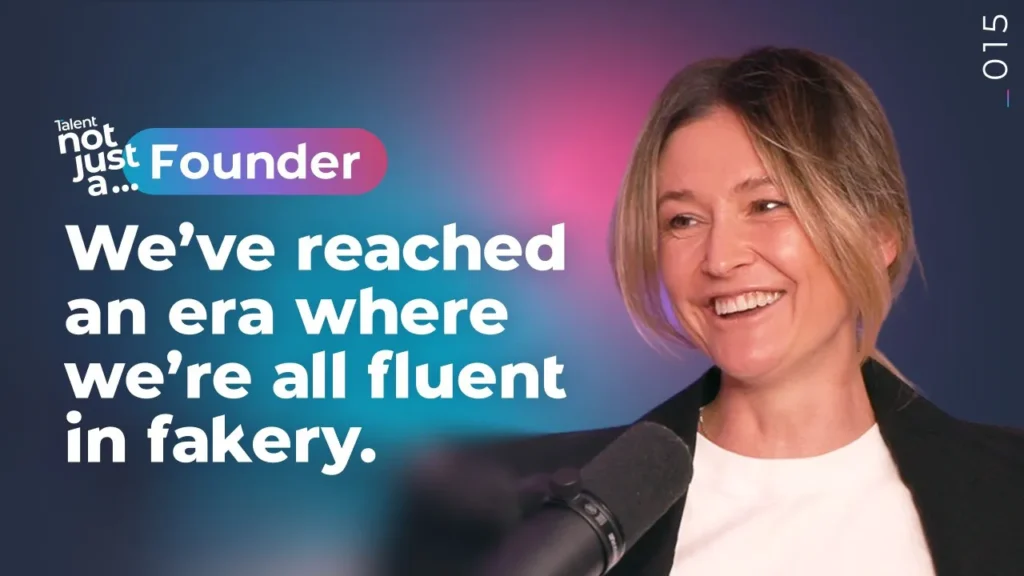
Georgia: It depends on the business at the time, but I think what you’re pointing to is we’ve reached an era where collectively we’re all fluent in fakery.
We all know what it looks like to add a little filter to our sunset on Instagram. We’ve all looked at the Google review and gone, is that legit? Am I being catfished on this dating app?
We don’t necessarily trust the perfect and the polished. There’s this friction online. So anything that shows a level of humanity, or breaks the pattern of our expectations, develops trust.
Whether you do that through humour, like the New South Wales Police legends, or with emotion, or with humility, like admitting that you’re still learning — that’s why Mel Robbins is so powerful and popular. She’s the number one thought leader in the world now, and she talks a lot about, “Hey, I don’t know everything.”
Amanda: Who do you think is doing thought leadership well?
Georgia: I think Zoe Foster Blake here in Oz has done an extraordinary job of developing a voice that feels credible and human. She definitely has an element of thought leadership, although she isn’t teaching.
Typically, a thought leader like Gabby Bernstein or Mel Robbins or Simon Sinek or Gary Vaynerchuk — they’re all teachers.
We’ve definitely entered that era. In Australia, it’s still evolving. We’re hungering for those voices now.
Any big brand that is willing and brave enough to put their CEO in the podcast studio, or let them speak for themselves on LinkedIn, any company that’s doing that is winning the hearts and minds of its consumers. That is basically the way of the world now.
I think Tim Duggan does this well. He started in youth culture, then became a publisher of Junkee Media, which he founded and sold. He’s moved overseas. He still runs a publisher’s alliance here in Australia. A lot of people in media will know who he is.
He’s done a fantastic job of combining his authentic voice, which is very community-based and about the industry, with his personal experience.
Amanda: What’s something you’re deeply passionate about that would surprise people who only know you professionally?
Georgia: The older I get and the more experienced I become, the more I realise I really don’t know.
I think 10 years ago, we had this era of leadership which was very masculine. It was very about the guru. Follow me, I know the way. This is how we do things. I have the answers.
Last year, at South by Southwest, I went to a talk with Laura Henshaw, the co-founder of Kic. She got up in front of the room and said, “I don’t know what I’m doing half the time.”
For me, that was a really defining moment because what she was showing was that there is a feminine way to do leadership, which is based in outsourcing expertise to the community.
She said, “I lean on my team a lot.” Obviously, she leads them, but she’s often saying things like, “I’m not quite sure that this is the right direction, but we’re going to get through this and learn it together.”
Leadership needs to be strong and clear and firm. We do need a direction and there needs to be some certainty. But there also needs to be increasing space for softness and humanity and humility.
For me in particular, that was a really pivotal day because somebody who I both personally and professionally admired, who was a thought leader, who absolutely embodied that guru-style of leading, actually committed suicide that same day.
So it was a very defining moment in thinking about what it looked like to be a leader who is visible moving forward and how I wanted to represent myself.
Two years ago, you wouldn’t have caught me admitting that I didn’t know what I was doing. Now, I think the fact of the matter is, I have a lot of expertise and a lot of lived experience, as do you. I definitely know some things, but I also don’t know a lot of things.
I think that’s actually an immensely powerful statement to make.
Amanda: Essentially, you’re passionate about the realness, the authenticity and not having all the answers as a leader. Is that what you would say to sum it up?
Georgia: I would say that I am passionate about the new style of leadership.
A new style of leadership is one that is transparent and congruent with who you are. The more you can risk showing who you are, the more you will develop trust with people that will have them buy into you and buy from you.
As we enter this new age of communicating, where we are entering a time of personal media, those of us who are awesome people offline will build awesome brands online.
I’m passionate about this because what this says to me is that as we move into this age of AI, what’s more important than ever is being an awesome human.
Amanda: Do you think people feel pressure to perform at work?
Georgia: I think most of us feel a real pressure to perform. It shows up differently for men and women.
Men definitely have it. Their whole way of being is to challenge each other, to butt heads and determine who sits where in the hierarchy.
Whereas for women, we are often looking to others for the sense of permissiveness that says, “Oh, it’s okay for me to show up as myself.”
I do think, probably as emotional beings, typically we as females probably feel imposter syndrome more intensely. But I think it’s something we all struggle with.
Amanda: I think there’s a shift happening where people are giving themselves more permission to show more sides of who they are.
Georgia: I think what I’m hearing from you is that it feels a little bit like another variation of the same theme, which is as we move into this new world, there is less expectation to be one-dimensional and perfect.
There’s much more space to just be honest. “I’m a mother as well as a professional at work. I have a life outside of my job. Even though I love my job, I am still a growing human. I don’t have all the answers.”
Really, what it sounds like you’re talking about there, and I think is an ongoing battle for all of us, is the theme of self-permission.
How can I give myself permission to forgive myself, to be enough as I am right now? Oh my gosh, we’re going so deep.
Amanda: If you could be known for something completely different than what you’re known for now, what would it be?
Georgia: I’d really, really love to be a professional skier.
It’s really hard. I love skiing, but I’m just good enough to know that I’m not good.
I was lucky enough a couple of years ago to spend a day trailing a downhill Olympic racing champion in Canada. It was amazing. Following him for a day, I really understood, oh, this is how you ski well.
All I did was blindly follow along behind him. I didn’t stop to think. I didn’t fight the mountain. I didn’t fight the speed. Wherever he went, I went.
Normally, when you’re skiing, there’s a lot of uncertainty. What’s over this hill? It’s hard. I’m typically trying to manage and control a lot before it’s happened.
When I was with him, because he’s done it so much and there’s so much muscle memory, I just made the decision to trust him. We skied so fast. I will never get that again, but I love going fast. I love speed.
I hate being cold, so I don’t know that I could actually be a professional skier realistically.
Anything that takes me out of my head, maybe this is because I had an eating disorder and I definitely have the addict gene, anything that takes me out of my body or out of now, I love.
Amanda: How often you ski a year?
Georgia: Maybe once, if I’m lucky. It’s a pipe dream, baby.
I would recommend skiing generally. It’s such an awkward thing to do as an adult, learning to ski.
I do think so many Australians are obsessed with skiing precisely because we can’t really do it that much. We always want what we can’t have.
Other than that, if I weren’t doing what I was doing now, I would want to be doing something that fulfilled the Golden Triangle.
I would want to be doing something that paid me well, that gave me impact on other people and a sense of recognition, I guess, or connection. I would want to feel that I was doing something meaningful.
Money, impact and meaning — they’re the three things we all want from our lives and our careers. If you don’t have all three of those, you will feel out of alignment and a bit like your soul is being crushed.
That prism, the Golden Triangle, is what I measure every opportunity through.
I think about this quite a bit.
There’s the 80% investment rule, which is that most people get to a point in their careers where they’ve invested 80%. They’ve done eight years in a career, they’ve developed a good amount of subject matter expertise, and then they get itchy.
They basically get rid of that mortgage and start again. Whereas if they just paid down another two years, that’s when they would get the next level of success they really wanted.
I often think about that when I find myself getting restless, irritable or discontent with my current career path, which is normal. We all go through periods of, is this right? Am I bored? Does this still have meaning for me?
But commitment is important.
One thing I find really helpful that helps me stay the course and stay committed to my journey is I often go “earth”. I zoom right out and I say to myself, is the decision that I’m making to go in this direction something that I will look back on in 20 years’ time and regret or not?
If I feel excited by it and I feel this is tied to what I want for myself longer term, then it’s a yes.
Every time I have blown up a company, which I’ve done a couple of times, every time I’ve said no to an opportunity, which is also really hard, every time I’ve had to navigate some kind of tricky situation, which as a founder you have to do a lot, you’re following your instincts a lot of the time.
Making decisions has to be based on external circumstances and climate and context and all those things. But much more importantly, it has to be intrinsically aligned with the values of who you are and what you care about and what you want for yourself.
Honestly, I think that’s why I love entrepreneurialism so much because at the end of the day, you spend a lot more time dealing with yourself and your own thoughts and what you observe and see.
You have to get to know yourself quite well in order to cultivate a business, a life, a situation for yourself that is aligned with what you want. For that reason, it makes it a really beautiful but difficult tool for personal growth.
It’s not easy. It’s not for everyone.
Amanda: What is something outside of work that has changed how you show up at work?
Georgia: I was single for eight years and I fell in love about a year ago. That has had a really surprising impact on my willingness to show up in a new way at work.
I read some quote on Instagram that was like, “It’s amazing how dangerous you get when you know that you’re loved.”
I’ve been very career-driven and success-oriented for a really long time. Go, go, go. Do, do, do. Work is amazing for getting results because you do the job, you do the work, you press the button and you get the result.
But the older I get and the more I start to consider what I really want for myself next, and what is meaningful to me in my life, and the more I start to navigate saying yes or saying no to different decisions, the braver I’ve had to become.
One of those decisions for me recently has been the decision to really start stepping into my voice much more visibly. That is something I did when I was younger, but always with the backing of media houses.
Now I’m doing it on my own, and it’s quite a scary shift to make. Who am I to stand on my own without the credibility or the backing or the alignment of whoever I happen to be working with or for?
Falling in love has been amazing for that because it’s helped me see that I can show up as myself. Maybe actually people will love me, and I don’t need to be associated with some big brand in order to still have value.
Maybe that’s a long bow to draw. It’s super romantic. It could just be hormones.
The more authentically I have chosen to become more of myself, the more I have attracted clients, friends, people, a partner who really feel like me.
I do think it is manifestation. Your vibe attracts your tribe. That works in marketing, but I also think it’s very true in life. When you’re joyful and happy and also just being yourself, you’re going to attract other people who are joyful and happy and being themselves.
It’s just the way it works.
Amanda: How do these other sides of yourself show up in your work as a founder, even if you don’t realise it?
Georgia: When you’re a founder, every part of you impacts your business.
Every decision you make, every part of your vision, the way you choose to interpret things that are happening — inputs, cancellations, emails, requests — all of that is defined by your emotional state, your happiness levels, your emotional awareness, your level of maturity.
I think the success of your business and the rate at which it grows has to be linked inextricably to your personal growth and your willingness and ability to be brave and courageous, and also to believe that the best is happening for you.
That can be really tricky because there are constant roadblocks and challenges in business, especially when your income and the wealth of the business and the health of the business are tied to your personal health and wealth. It’s bumpy and scary, thrilling and addictive.
The way that I am and the state of my wellbeing shows up in every area of my business every day.
Probably one area where people don’t realise how the other areas of me show up and impact my work is in the way that I deal with my staff.
Employees, staff, contractors — they haven’t lived through what you’ve lived through in order to get to where you are. That’s why you’re hiring them to do a job. They can’t have the same level of awareness. They don’t know how hard it is to win the work. They don’t know how hard it is to manage them and help them be the best that they are while also doing your job.
Of course there’s not going to be empathy or awareness for that. That’s kind of your job as a leader. It’s one of the things about leadership that’s so hard. It’s not a very glorious job at all. You’re not the one at the top. You’re just the one who goes first.
My leadership is intrinsically linked to how well I’m looking after myself. The happier I am, the more well-fed I am, the safer and more certain I feel, the better I feel in my body, the more I’m looking after myself — going to the gym, eating well, getting enough sleep — all of those things have direct flow-on effects to the way I manage my staff and the decisions I’m making.
A healthy, happy founder is a healthy, happy business.
Amanda: Can you share a story from work that captures how being fully yourself has made you successful?
Georgia: During the pandemic in 2020, I was editor-at-large for Virgin Australia and I had a business called The Travel Bootcamp.
My business partner, who was Australia’s first professional Instagrammer, and I would put on events around Australia and New Zealand. They taught people the business of how to get paid to travel. We had a live event already booked and paid for, with 200 people due to attend in Melbourne.
So it was a live event teaching people how to get paid to travel in the world’s epicentre of COVID. Then my job with Virgin was, of course, to travel and be an ambassador for them.
At the beginning of 2020, every single income stream I had shut down overnight. In about three weeks, my entire calendar for basically the year got cancelled. Virgin actually went into voluntary administration, so my ambassadorship was put on pause. My business also got put on pause. I had no idea what I was going to do or how I was going to manage.
I was trapped at home, alone in my little apartment. I decided to start showing up online and sharing my predicament.
Quite amazingly, because I was honest about what was happening, all of this goodwill started to flow to me in ways that were completely unexpected.
One of the biggest things that happened was prior to Virgin, I had been the contributing editor to Tourism Australia. I’d held that role with them for three years. They saw that I had lost my job and they reached out to me and said, “We’re going to look after you.”
Because of the transparency with which I was showing up online and talking about what was happening for me, and how I was going to come up with solutions that were going to help others while also helping myself, it was a real lesson for me that your biggest mess often becomes the thing that leads to your greatest success.
That year, we went from two part-time staff to a team of 16. It was the year we cracked seven figures for the first time.
What started off as a complete disaster of a year for me led to a really honest moment online, which I was then rewarded for by people buying into the truth of what was happening for me.
Obviously, there was a lot of value that we gave and solutions. I didn’t stay in the mess. But I think what that really showed me was that it’s okay to show people that you don’t always have it all together.
A lot of the time, it is the moments where we say, “I’ve had a tough time,” or “I’m living through something,” that other people will extend a hand and say, “Here, I’m going to help you.”
Amanda: What would people be surprised to learn about what your job really involves?
Georgia: It’s very clear to me that we are now in the age of the thought leader, and it isn’t enough to build an impersonal brand anymore.
The brands that are going to have cut through in the next 20 years will absolutely be human and personal.
As I’ve been looking at the changing nature of communications and marketing and all of those trends, I’ve had to spend quite a lot of time researching, studying, strategising, developing my own thought leadership in that area.
That is what thought leadership is. It is to gaze at a problem and develop innovative leadership in your thinking.
I’m probably like you. I’m a pretty dynamic individual. I love to go. I love action. I love moving. I love getting things done.
At the moment, the really surprising thing for me — and I would imagine for a lot of people around me — is I’m spending a lot of time thinking, which is not usual for me.
We don’t want to stay in our heads too long, because if you get in your head, you’re dead. But it’s a wonderful thing to spend a bit of time being strategic and really developing subject matter authority and expertise.
Of course, we are rewarded in public for what we practise in private. Everything you do and work on on your own becomes what you’re rewarded for when you move out in the world.
That’s not just in business. That’s also in fitness. That’s in relationships. Everything that you see are just the results of what people have been working on quietly by themselves.
I honestly think the higher you get to joy, the more self-expressed you become and the more authentically yourself you are, the more coincidences tend to show up in your life.
It’s amazing.
I truly think the braver you can be in just following the breadcrumbs of what interests you and excites you and makes you more of you, the more the universe will reward you with messages, people, things, coincidences.
When we get into manifestation and vibration, the highest vibrations are basically peace and joy. The higher you vibrate, the closer you are to source.
The best thing you can do in order to cultivate more synchronicities in your life is to follow your joy. Joy is the breadcrumb that’s leading you the way you’re meant to go.
We can spend all our time in our heads, strategising and analysing data, but if it doesn’t make you feel good and it isn’t meaningful to you — and I don’t mean the kind of feel-good joy that’s, let’s eat the extra serving of ice cream and watch MAFS. That’s fun to do on occasion, but it’s not the thing that’s going to make you feel good in the long term.
All you really need to know, I truly believe, is following your joy. Because your joy is your blueprint to real success.
Amanda: Last question. What’s your hidden talent?
Georgia: One weird thing that not a lot of people know about me is I was born with a syndrome called hypermobility. What that means is I’m triple-jointed. I can put both my legs behind my head and walk on my hands. I can very easily do the splits.
It’s a good party trick. Not that I crack it out. Weirdly enough, it doesn’t make it onto the stage at conferences all that often.
I cultivate it now mostly through yoga, and that brings me a lot of joy.
I went through a period of trying to do a lot of weights and grow muscles. I injured myself and went to my physio. He was like, “Why are you doing this?”
I said, “I just feel like I should.”
And he said, “But your body is designed for dancing and yoga.”
He basically said, stop fighting yourself. Go and do the thing you’re designed for.
It feels good for me. Again, finding what feels good is key in business, key in life, key in fitness.
I do yoga a couple of times a week. I’m not crazy about it, but if I don’t do it, I get crazy. If I’m not exercising, if I’m not moving, if I’m not stretching…
Amanda: Georgia, thank you so much for joining us.
Georgia: Thank you so much for having me. It’s been a pleasure.
Enjoyed this episode?
Explore more conversations with inspiring leaders and innovators on our podcast or subscribe to our YouTube channel for the latest episodes.
We know that talented people know talented people. If you’d like to talk to us about how we can support your business, get in touch.