
Jason Waterhouse on high-performance sailing, pressure, and adventure
Jason Waterhouse on high-performance sailing, pressure, and adventure
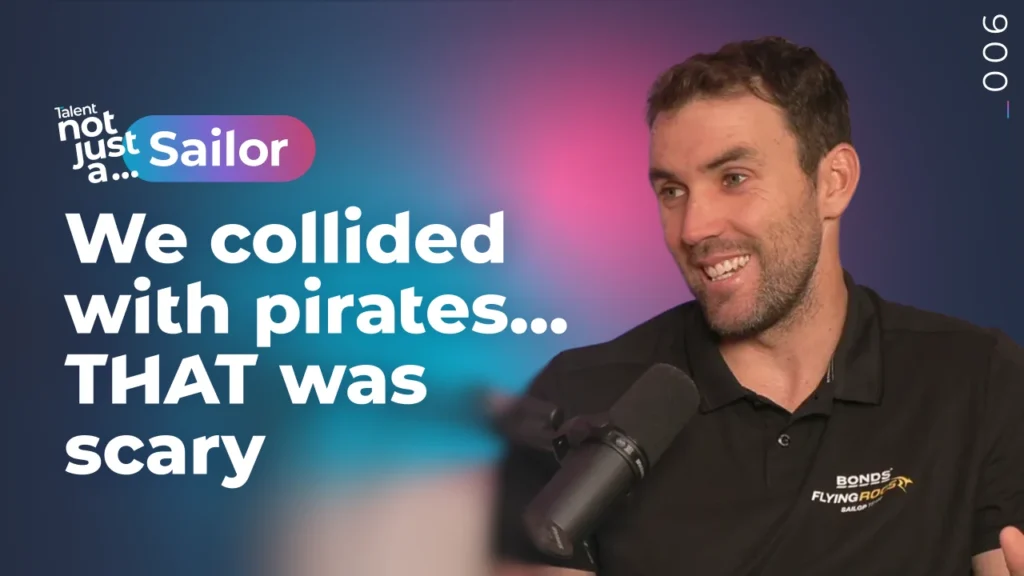
Jason Waterhouse’s career and achievements as a two-time Olympian and competitive sailor all leads back to his family and childhood. Passionate sailors, his parents bought a yacht back when he was younger, and the family set out from Sydney’s Northern beaches to sail around the world for four years.
This unconventional childhood is what fostered his love of the ocean and helped him build an impulse for adventure and instinct for problem-solving that would eventually carry him through the most demanding environments on the global stage.
We sat down with Jason for our latest podcast episode to find out the person, process, and passion behind the trophies.
Dealing with pressure as a competitive athlete
Competitive sailing wasn’t love at first sight for Jason, at eight years old he competed for the first time filled with nerves and zero interest in doing it again. But he kept at it until it all became his new norm. At 14, he qualified to represent Australia in the UK and his first taste of competing internationally was what “lit the candle” for Jason.
“Meeting international competitors, being part of something bigger — it was addictive,” he says.
His first big lesson in pressure came early. In the final race of his first major event, he and his partner went from a silver-medal position to completely off the podium in a single race. He laughs about it now, but it stuck, “The early exposure to pressure was valuable. I kept competing internationally and eventually won gold in Brazil on my fourth attempt.”
His progress came in repetition: racing, reviewing, refining… Slowly getting more comfortable performing under pressure.
His time as an Olympian
Jason’s Olympic story spans across two Games with completely different atmospheres. Rio 2016 offered the classic Olympic experience: an electric city, dense crowds, families lining the foreshore, and a sense of shared excitement that athletes often describe as once in a lifetime.
Then came Tokyo 2020 in the middle of an unprecedented global pandemic. No spectators, no family, no movement outside the village. “It was a completely different experience,” he says. “But I was grateful it went ahead.”
Between the two Games he had become a consistent performer in mixed-gender catamaran racing with his cousin and sailing partner, Lisa Darmanin, and their ability to communicate clearly under pressure and adapt to each other’s styles became their edge.
After Tokyo, Jason began preparing for Paris but two things happened: he became a father, and he received an opportunity to join the America’s Cup in Barcelona. “It was the toughest professional call I’ve had to make,” he says, “but no regrets.”
SailGP and the art of flying a boat
While Olympic sailing focuses on technical skill, endurance, and tactical precision, SailGP is a high-speed, high-tech spectacle built for thrilling, rapid-fire racing.
SailGP races are tight and each person on board has a highly specialised role, and Jason’s is one of the most technical: flight controller. “I control the hydrofoils — lifting the boat, balancing it, and keeping it efficient,” he says. “It’s very precise.”
The difference between a smooth race and a costly mistake can be millimetres and milliseconds. Beyond the 20-minute race window, the sport is about the travel load, the weight requirements, the physical strain, and the need to think clearly while moving at speeds where the smallest miscalculation gets amplified.
People also often assume the biggest challenge is the racing, but Jason disagrees, sharing, “I’ve had injuries since I was 14 and managing them is a big part of the job.” So much of the elite sport sits outside of public view, and training becomes as much about staying mobile and pain-free as it is about strength or speed. Rehab becomes routine, and working with physios and sports psychologists becomes part of the support structure that keeps him performing at the level required.
Communication: the skill that holds it all together
Ask Jason what he considers one of his core strengths, and he’ll point to communication. Shaped by years of working with crews of different cultures from Australia, New Zealand, Austria, Switzerland, and Japan, he’s gained the ability to understand how different people read information, process pressure, and collaborate.
This showed up repeatedly in his partnership with Darmanin, and their contrasting communication styles were something they learned to leverage. It meant reading each other, setting each other up, and understanding what each person needed before stepping into high-pressure environments.
The same skillset helped him navigate a key moment in SailGP. Before a season-defining race in San Francisco, a poor training day left him feeling off. Instead of trying to conceal it, he told his teammates directly and it reset the tone. They regrouped, adjusted, and performed the next day with clarity.
In a sport where pressure is constant and decisions are instantaneous, he shares that those conversations often dictate outcomes as much as raw skill does.
Life on the move, and life as a dad
The reality of Jason’s life as a sailor is the amount of time he spends up in the air travelling, with SailGP having 12-13 events a year. A huge part of his behind the scenes is managing flight itineraries, hotel rooms, time zone changes, and a schedule that rarely looks the same month-to-month.
Among all of this, his family is an important centre of gravity for Jason, and becoming a father added a new dimension to his relationship with risk and routine. It also gave him a fresh appreciation for the decisions his parents made two decades ago.
“When I think about taking my daughter out the way my parents took me, I suddenly understand the courage it took,” he says. “It hits differently.”
Handling long stretches solo while he’s overseas, Jason shares that the moment he walks through the door, the handover is instant, “[My wife] just hands me the baby sometimes and goes, ‘Your turn.’ And you’re just like, what time zone am I on? But it’s such a privilege — these are such little small world problems.”
The work behind the wins
Strip away the titles and trophies and Jason’s career looks less like a straight line of achievements and more like a long stretch of disciplined behind-the-scenes work which is the very foundation of how he performs and lives.
Jason is an athlete shaped by an unconventional childhood, a skilled communicator, and a competitor who understands that the work off the water is often what determines what happens on it.
Want to hear more of Jason’s story in his own words? Watch the full podcast episode on our YouTube channel.