
Dom Price on curiosity, cooking and calling Australia home
Dom Price on curiosity, cooking and calling Australia home
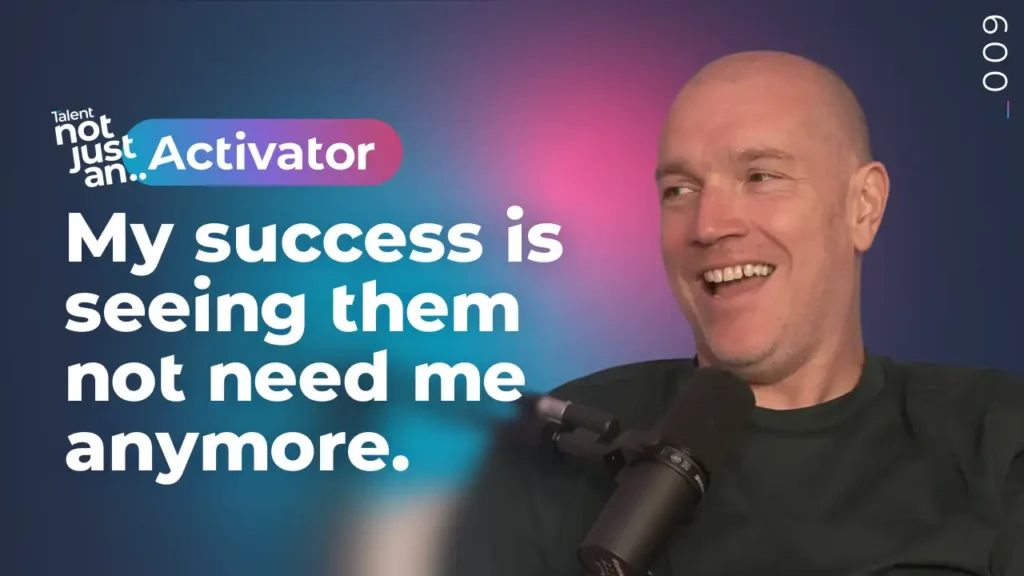
We recently sat down with Dom Price on our latest podcast episode, and it didn’t take long to understand why his work resonates with so many people navigating modern workplaces.
Dom has spent years helping organisations rethink leadership, systems, and culture. He speaks to executives, teams, and communities around the world about the future of work as something people are already living day to day, rather than a distant concept.
However, behind his job, he’s someone driven less by answers and more by questions; someone who’s deeply curious about how work actually feels and why so many well-intentioned organisations keep getting in their own way.
A childhood shaped by questions
Dom describes himself as a curious kid; the kind who always wanted to understand why.
“I asked a lot of questions,” he says. “Probably too many questions.”
And that curiosity didn’t always make him popular in classrooms.
“I was the kind of kid who always wanted to understand why things worked the way they did. That showed up at school, sometimes to my teachers’ frustration. I wasn’t disruptive, but I was definitely challenging. If something didn’t make sense to me, I’d ask why we were doing it that way. And sometimes the answer was, ‘Because that’s how it’s always been done.’”
Even as a child, this answer didn’t sit well with him. As he looks back, Dom sees a direct correlation between those early frustrations with the work he does now.
He’s still asking the same questions but now, it’s just at organisational scale: Why do we work like this? Who is this system really serving? What would happen if we designed work around people instead of control?
The gap between intention and reality
One of the themes Dom returns to again and again is the disconnect between what organisations say and what their systems actually do.
“People say, ‘We trust our teams,’” he explains. “But then they put layers of approval and control in place. And I couldn’t stop asking, ‘If you trust them, why does the system say otherwise?’”
This contradiction fascinates him. From his perspective, most workplaces don’t have a people problem.
“They have a system problem.”
Leaders ask people to collaborate more, innovate more, speak up more — without changing the environment they’re operating in.
“We reward compliance,” he says, “and then wonder why no one takes risks.”
Management, leadership, and the illusion of control
Dom is careful to distinguish between management and leadership, terms he explains are often used interchangeably, but shouldn’t be.
“They’re not [the same]. Management is about control. Leadership is about influence. Management asks, ‘Are you doing the thing?’ Leadership asks, ‘Are we doing the right thing?’ And a lot of organisations confuse the two.
“[This confusion happens] because management feels safer. Control gives the illusion of certainty. If I can measure it, approve it, and sign it off, I feel like I’m reducing risk.”
But that sense of safety is often an illusion. The more control organisations add, the slower and less adaptable they become, and it erodes the very trust that everyone says they want.
“Every leadership offsite starts with, “We trust our people.” And then you look at the system and think, “No you don’t.” If you trusted them, you wouldn’t need five layers of approval to buy a pen or make a decision that’s well within their role. We say we want autonomy, but we design environments that punish it.”
If it takes five layers of approvals to make a decision, the message is clear even if no-one says it out loud.
Psychological safety isn’t a buzzword
‘Psychological safety’ is a term Dom has always used deliberately.
“It’s about whether it’s safe to speak up,” he says. “Can I ask a question without being embarrassed? Can I challenge an idea without being punished? Can I admit I don’t know something? If the answer to those is no, then you don’t have psychological safety — no matter what your values poster says.”
Without that safety, he explains that everything else breaks down.
“You can’t have innovation without safety. You can’t have learning without safety. You can’t have accountability without safety.”
Instead, people retreat; they do the minimum and they protect themselves.
“And then leaders say, ‘Why is no-one engaged?’”
His frustration lies in the systems businesses have adopted across the board without question, directed at structures that ask for bravery and innovation while quietly penalising experimentation and questioning the status quo.
And this shows up in how most leaders are promoted into their roles.
Promoted into leadership, untrained for humans
One reason Dom has empathy for business leaders is that many of them were never set up to succeed.
“Most leaders were promoted because they were good at their jobs — not because they were good at leading people. And then we don’t train them. We just say, ‘Congrats, now you’re responsible for humans.’”
It’s something Dom finds astonishing and found himself questioning.
“We’d never do that with a system or a process, but we do it with people all the time.”
And the result is a generation of well-meaning leaders trying to do the right thing without the tools to do it well.
From a short stay to calling Australia home
Dom didn’t move to Australia intending to stay.
“The idea was I was only coming out here for a year and a half,” he says. “I’m like, I’ll play with it, I’ll taste it. Do a year and a half. And I had a plan to move back to the UK.”
At 24, the decision wasn’t part of a carefully mapped-out strategy. The same role he was doing in London existed in New York and Sydney.
“My instinct was… New York would be too much like London. So why not try the other thing?”
In London, his department was 450 people. In Sydney, it was 23. “If I’m one of 24, I think I’ll learn more than being one in 450.”
It first started with one Easter missed, then Christmas, then he went back home. And once he arrived, something had changed.
After a trip back to the UK, he was on the phone to his mum. “She’s like, ‘How’s it feel? You’re back?’ And I said, ‘You know what it’s like… it’s just so nice to get home.’ And I just said it. Normally. Didn’t even think.” There was a pause. “Well… that’s not your home. This is your home.”
“There’s no one day where it just became home,” he says. “It just kind of evolved over time.”
Permanent residency, citizenship, marriage. Instead of a milestone moment, at some point without announcing it, Australia stopped being the experiment and became home.
Failure, ego, and success
Failure has been one of Dom’s biggest teachers.
“I’ve failed plenty of times,” he says. “Projects that didn’t land. Ideas that didn’t work. Moments where I thought I had the right answer and absolutely didn’t. But I don’t see failure as a negative thing anymore.
“Early on, failure felt personal. Like it was a reflection of my capability or worth. Now I see it as data. Something didn’t work. Why? What can I learn from that? If you remove the ego from it, failure becomes incredibly useful.”
Removing ego from failure changes everything, and this shift in mindset turns mistakes into learning instead of shame. But this attitude change doesn’t happen automatically.
“No one enjoys getting something wrong,” Dom says. “But the organisations that grow are the ones that make it safe to experiment and safe to fail.”
When asked how he measure success now, Dom’s answer is simple: “Impact.”
If someone walks away thinking differently, acting differently, or feeling more confident to try something — he says that’s enough.
Titles matter far less to him than contribution.
“If you strip away the job title, what’s left?” he asks. “What value are you actually adding?”
It’s a question he applies to himself as much as to others.
Cooking without a recipe
Outside of work, Dom loves to cook.
“Cooking has just become such an important part of my life. I love it. […] This really frustrates my wife,” he laughs. “But I’ve never followed a recipe. I just make stuff up as I go along.”
And his spontaneity means meals are rarely replicated exactly.
“Every now and then you take something and go, ‘Can you make that again?’ And I’m like, yeah… maybe kind of something similar.”
For Dom, it’s creative release.
“I genuinely find it’s like a recharge for me,” he says. “The creativity side… the freedom, the liberation, the challenge… Where I get a real kick from it is seeing other people eat my food and enjoy it.”
His wife is a nutritionist and over time he’s realised their worlds aren’t as different as he first thought.
“When we first started dating, I thought what I did and what she did were completely different to each other. But the more I’ve become curious and interested in nutrition and wellness, I’m like, oh my God — what an overlap to the business world.”
What stood out to him was how she works.
“Even just the way she thinks about diagnosing before solving… the more holistic form of medicine. It’s not tablets or supplements or exercise or diet — it’s ‘and’.”
To Dom, that principle of diagnosing before you solve feels just as relevant in leadership.
“When you learn nutrition, you learn about mass population. But when you practice nutrition, every patient is different. And when you learn business, you learn generic case studies. So, if I go into any business and I don’t listen and learn for that nuance — the very unique elements — I will 100% recommend something that’s irrelevant.”
Completely different professions but more in common than you’d expect.
Not just an Activator
For a long time, Dom’s sense of self was closely tied to his work.
“If work was going well, I felt good. If it wasn’t, I felt like I was failing as a person.”
And untangling his work from him as a person took time.
“Work is something I do, not who I am,” he explains.
While he still cares deeply about the work he does, it’s no longer the only source of meaning.
“Relationships, health, curiosity, contribution outside of paid work — those things matter too.”
In a world that often leads with, “So, what do you do?” in Dom’s perspective, he says, “We lead with job titles as a shortcut to understanding someone. But it’s such a narrow slice of who they are.”
He’s built a career around helping organisations change how they work, but his real impact comes from how he thinks.
Dom’s interests don’t lie in certainty or performative leadership, he likes examining systems, behaviours, and the tactical everyday moments that quietly shape culture.
Not just an Activator, Dom is, by default, a challenger; someone who’s curious and believes work can be better and more human.
“We don’t need leaders who have all the answers,” he says. “We need leaders who ask better questions. Certainty shuts down conversation. Curiosity opens it up.”
Want to hear more of Dom’s story? Watch the full podcast episode on our YouTube channel.